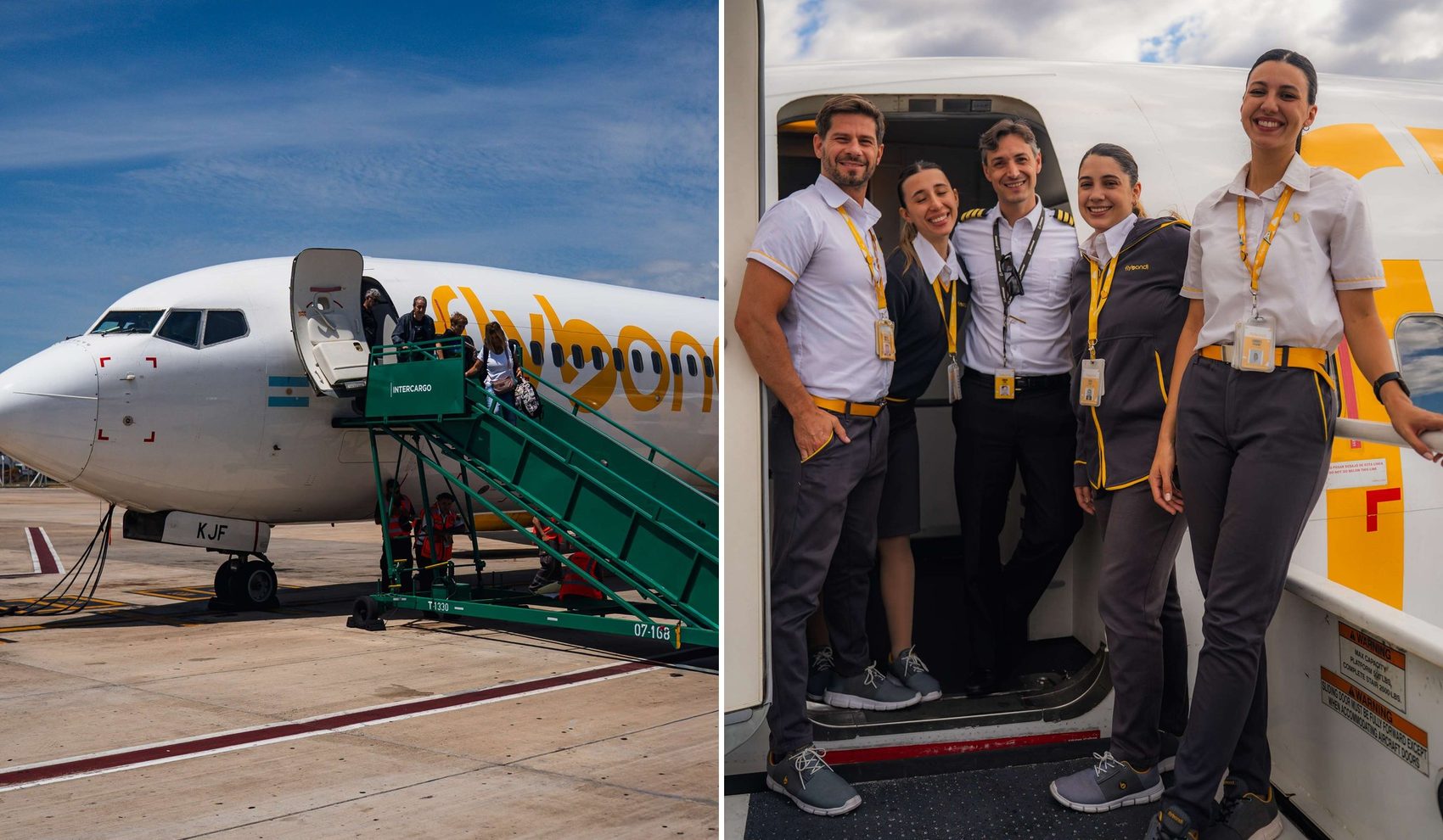
Flybondi, Argentina’s largest low-cost carrier, has not flown since August 6 (33 days as of September 8), with cancellations at 75% in one month and its owner pursuing a bankruptcy restructuring.
This is far from the airline’s first grounding this year. Flybondi suspended operations for roughly two weeks in mid-July before briefly resuming service, but cancellations kept mounting. By early August it had cut about 75% of its scheduled flights, and on August 6 it stopped flying altogether. Its website went dark for about a week in mid-August before reactivating on August 23–24 to sell tickets again, even though no aircraft were in the air.
The airline’s record on cancellations and refunds predates the shutdown and appears to be its own doing rather than a product of weather or broader industry conditions: an analysis by the fact-checking outlet Chequeado found Flybondi’s flight non-compliance rate ran roughly ten times higher than Aerolineas Argentinas or JetSMART’s over the same October 2025–January 2026 window. Provincial consumer-protection agencies have fined the airline repeatedly, including 300 million pesos (Approx. US $196k) from Buenos Aires Province in February over more than 2,400 complaints and a combined 392 million pesos (Approx. US $256k) from Neuquen in August, both under appeal. Chequeado reported in August that Flybondi had issued no refunds at all to hundreds of affected passengers over the prior eight months.
According to data from the civil aviation regulator ANAC cited by Chequeado, Flybondi canceled 20.4% of its scheduled flights in 2026 through early September (2,081 of 10,204), with the cancellation rate climbing to 36% since April 1. In July alone, 75% of flights were canceled and the airline operated only 153 flights, down from 2,105 in July 2025. Separate reporting has put the toll since the start of the 2026 summer season at roughly 2,500 canceled flights and 350,000 affected passengers.
The airline’s finances have deteriorated alongside its schedule. Estimated total liabilities run to about $120 million, with assets covering less than 10% of that debt, according to La Nación. Flybondi owes Argentina’s tax authority, ARCA, roughly 1.53 billion pesos in back taxes (Approx. US $1 million), a figure that rises to about 1.75 billion pesos with interest (Approx. US $1.14 million). Reporting has also cited more than 1.2 billion pesos in bounced checks over a six-week period (Approx. US $785k), a bankruptcy petition tied to more than 660 million pesos in unpaid debt (Approx. US $430k), and judicial account freezes variously reported between roughly 122 million and 1.5 billion pesos (Approx. US $80k to US $980k). As of September 7, the company was still said to be evaluating a formal court-supervised restructuring (concurso preventivo) rather than having filed one.
Employees have not been paid since June, and more than 700 labor claims are reportedly pending against the airline. The pilots’ union, Asociación de Pilotos de Líneas Aéreas (APLA), has been sharply critical of how the airline has been run. Union leader Pablo Biró has described Flybondi’s business model as an “esquema ponzi” and said it was fortunate the crisis has not already produced a serious accident, while accusing the national government of shielding the company from consequences.
Flybondi has been controlled since June 2025 by COC Global Enterprise, an investment group led by Leonardo Scatturice, which pledged to invest $1.7 billion in the airline; reporting suggests only about $70 million of that has materialized. Scatturice also controls OCA, an Argentine logistics company that has been in its own court-supervised restructuring since June 2025. His group is reportedly exploring folding Flybondi into a new entity, OCA Air S.A., and pursuing a joint “economic group” bankruptcy filing covering both companies, an approach that faces legal challenges under Article 65 of Argentina’s bankruptcy law. As of early September, that restructuring had not been executed.
ANAC has carried out 36 inspections of Flybondi since December 2024, issued roughly 54.7 million pesos in fines (Approx. US $36k) across 38 enforcement actions, and has 22 additional cases pending that could add more than 450 million pesos in penalties (Approx. US $294k); the regulator has nonetheless approved a corrective action plan that allows the airline to keep selling tickets despite the groundings. Brazil’s aviation authority, ANAC Brasil, barred Flybondi from selling tickets to Florianópolis, Maceió and Salvador and extended the restriction to Rio de Janeiro in August after roughly 80% of its Brazil routes were canceled in July, citing “deficiencies in consumer service, reimbursement management, and passenger assistance” that it attributed to the airline itself rather than any safety concern.
Conflicting timelines have circulated for when flights might resume. One report tied to the airline’s own website reactivation pointed to a Buenos Aires-Bariloche route restarting around September 10–11; a separate account describes a plan for only three aircraft to return to service under the OCA Air brand starting September 20. As of September 8, no flight had actually resumed, and any restart date should be treated as a company projection rather than a confirmed schedule.