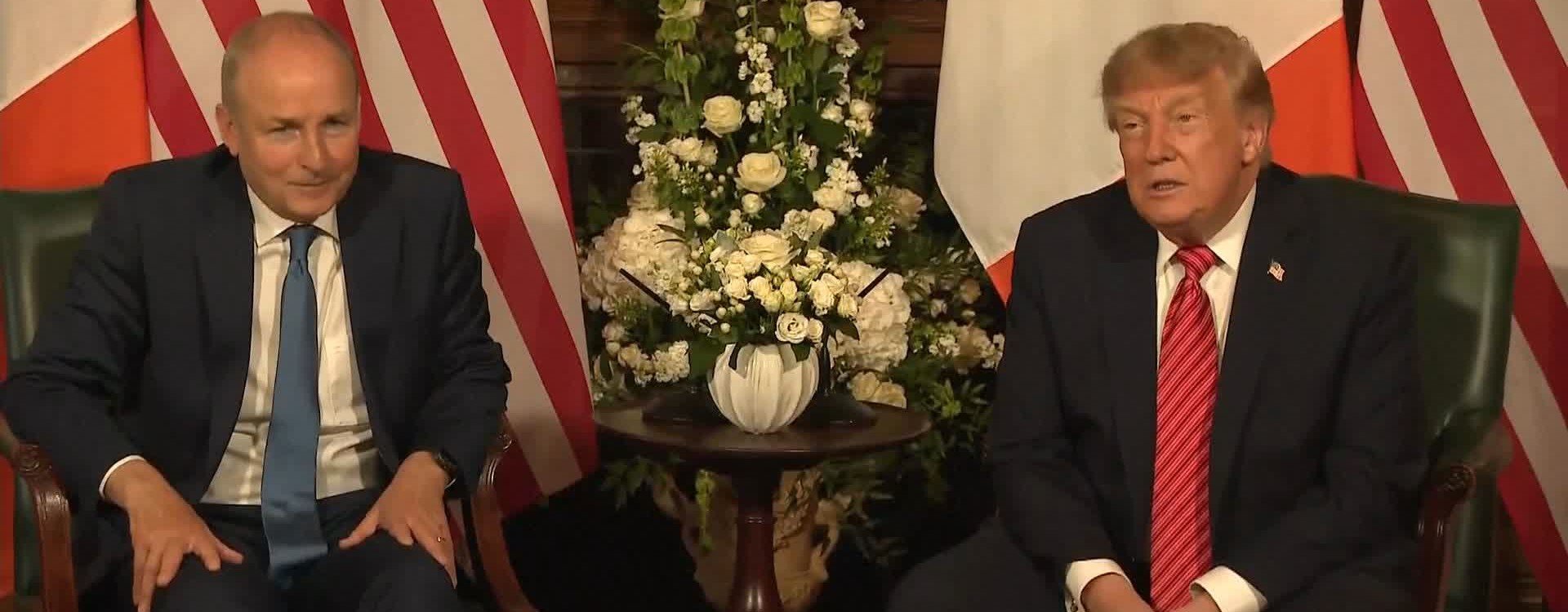
President Trump said Saturday he believes he could personally "settle" a potential military conflict over the Malvinas (Falkland Islands), calling the prospect of a UK-Argentina clash a "potential disaster" during a visit to Dublin, Ireland. "I'm sure I'll be called into that potential disaster, but if they do, I'll probably be able to settle, settle it out," Trump told reporters alongside Irish Taoiseach Micheal Martin.
The remarks came as Trump also questioned whether Britain would, or even could, deploy military forces to defend the islands, pointing to domestic pressures in the UK including immigration and energy costs. It is the most direct offer of American mediation Trump has made since he first cast doubt on unconditional US backing for Britain in the dispute earlier this month, a shift President Milei's government has repeatedly cited as vindication for its harder line on the islands.
Washington has maintained a policy of formal neutrality on Falklands sovereignty for decades, treating it as a bilateral matter between London and Buenos Aires rather than one requiring a US position. A sitting American president volunteering to personally broker a resolution, even in an offhand remark to reporters, is a departure from that posture and gives Milei's government fresh rhetorical ammunition even though Trump did not endorse Argentina's sovereignty claim itself.
The timing is awkward for Britain's own messaging on the islands. Just three days earlier, Prime Minister Andy Burnham told Parliament the UK would be "relentless" in defending the Malvinas (Falkland Islands), rejecting Milei's assertion that the roughly 3,200 island residents have no legitimate claim to self-determination and insisting Britain would "always respect" their right to "choose to be British." Trump's offer to personally "settle" the matter cuts against that framing in two ways: it treats the dispute as a live negotiation rather than a closed question of self-determination, and it raises the possibility that Washington, rather than London or the islanders themselves, could end up shaping how it is resolved.
Neither the British government nor Argentina's Foreign Ministry had issued a formal response to the comments as of Saturday. British officials have historically avoided engaging with speculation about American mediation on the Falklands, wary of appearing to concede that a dispute over sovereignty exists at all rather than a settled matter of self-determination for the islands' residents.
Trump has a history of making expansive, off-the-cuff claims about foreign disputes that he does not always follow up on, and Saturday's comments came during a trip built around a stop at his Doonbeg golf course rather than any scheduled discussion of South Atlantic policy. But the substance complicates the picture for both governments regardless of whether it leads anywhere. It hands Milei a talking point about apparent American sympathy without committing the United States to anything concrete, and it leaves Burnham having to either engage with an unsolicited American mediation offer or ignore a sitting US president's public remarks about a territory his government treats as non-negotiable.
The comments land a day after Argentina published a decree formally tying all state agencies' foreign dealings to the Malvinas (Falkland Islands) sovereignty claim, and less than a week after Milei canceled a planned London trip as the sanctions standoff over oil exploration near the islands deepened. Whether Trump's offer amounts to anything beyond a passing remark on a foreign trip focused mainly on golf and immigration politics remains to be seen, but it keeps the American president's shifting rhetoric at the center of a dispute that Argentina's government has worked hard to internationalize.