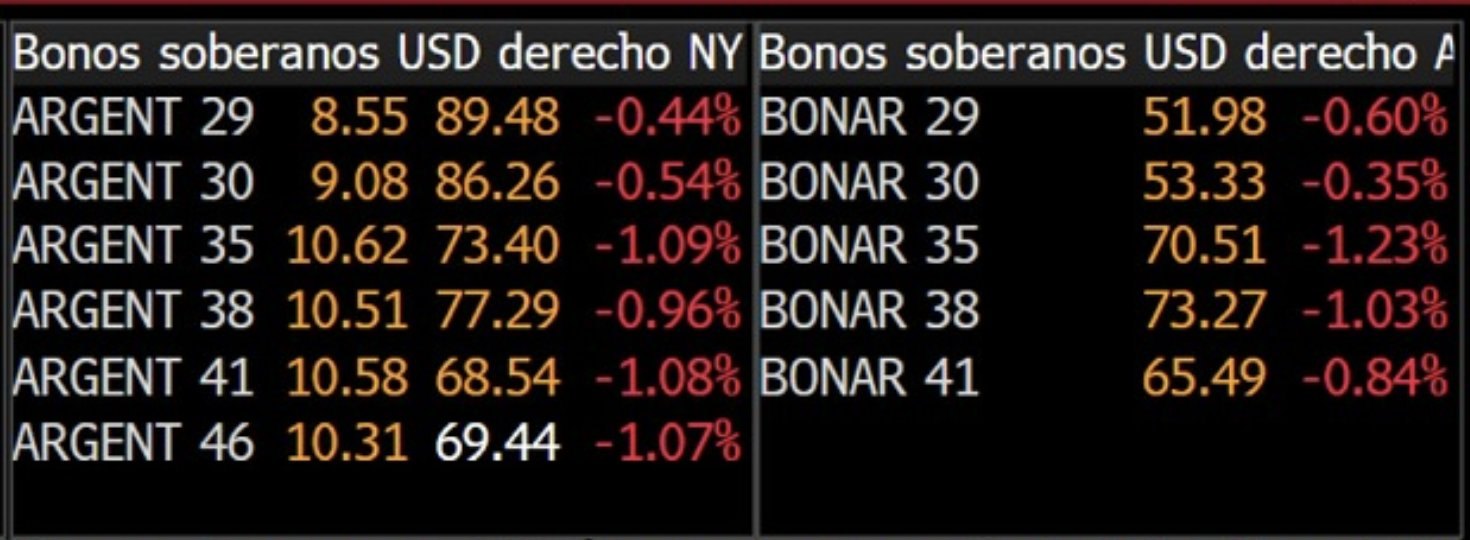
Argentina's country risk premium climbed for an eighth consecutive session on Wednesday to around 556 basis points, its highest level in roughly five months, as the International Monetary Fund's review team worked through the Central Bank's books and investors questioned how quickly Argentina can rebuild its reserves.
The JP Morgan index, which measures the extra yield investors demand to hold Argentine debt over US Treasuries, is up about 8.4% so far in September. Dollar bonds under New York law fell as much as 1% on Wednesday, extending five-day losses to around 3%. It is a sharp turn from earlier this month, when Argentine assets shrugged off a global bond selloff and the Treasury rolled over 103% of its maturing debt.
What's Driving It
Traders point to a mix of global and local factors: higher US interest rates, with 10-year Treasury yields near 5%, and a slowdown in the Central Bank's dollar purchases. "The international context has become considerably more demanding," said Fernando Camusso of Rafaela Capital, adding that investors are scrutinizing reserve accumulation, debt maturities and Argentina's options for refinancing in 2027. Andrés Reschini of F2 Soluciones warned that "2027 will be more challenging."
The IMF Review
The selloff coincides with the IMF mission that arrived Monday to open the third review of Argentina's program, now led by new mission chief Joyce Wong, who replaced Bikas Joshi. The economic team met the Fund's staff at the Central Bank without Economy Minister Luis Caputo, who was in New York with Milei. There, Caputo met Wall Street investors and said the government does not plan to issue international debt at current rates.
The June reserve target that will anchor this review was met. Since January, the Central Bank has bought more than $14.3 billion in the foreign exchange market, well above the roughly $10 billion it had informally aimed for. But purchases are not the same as the net reserves the IMF measures, and analysts say the year-end goal of minus $4.1 billion is still far off. "By the end of the year, the Central Bank should accumulate $8 billion in net reserves, and it still hasn't achieved that," said Lorenzo Sigaut Gravina of Equilibra. "The slowdown in dollar purchases in the market is telling you that it won't be so easy to accumulate."
What's at Stake
The stakes are concrete. Approval of the review would unlock a disbursement of roughly $860 million, and Argentina owes the IMF a principal payment of about $800 million on Friday. Next year, maturities include about $6 billion to the Fund and $13 billion to private creditors. The Central Bank has counted on corporate dollar inflows as one cushion, but economists caution that reserves alone won't settle the question. "Thinking that having accumulated $8 billion in reserves is enough to bring down country risk or get through the period until the elections without turbulence is a mistake," said Lucio Garay Méndez of EcoGo.
Finance Secretary Federico Furiase struck a confident tone about the talks. "The dialogue is spectacular, and we are always in a very good position to exchange views on every variable," he said.