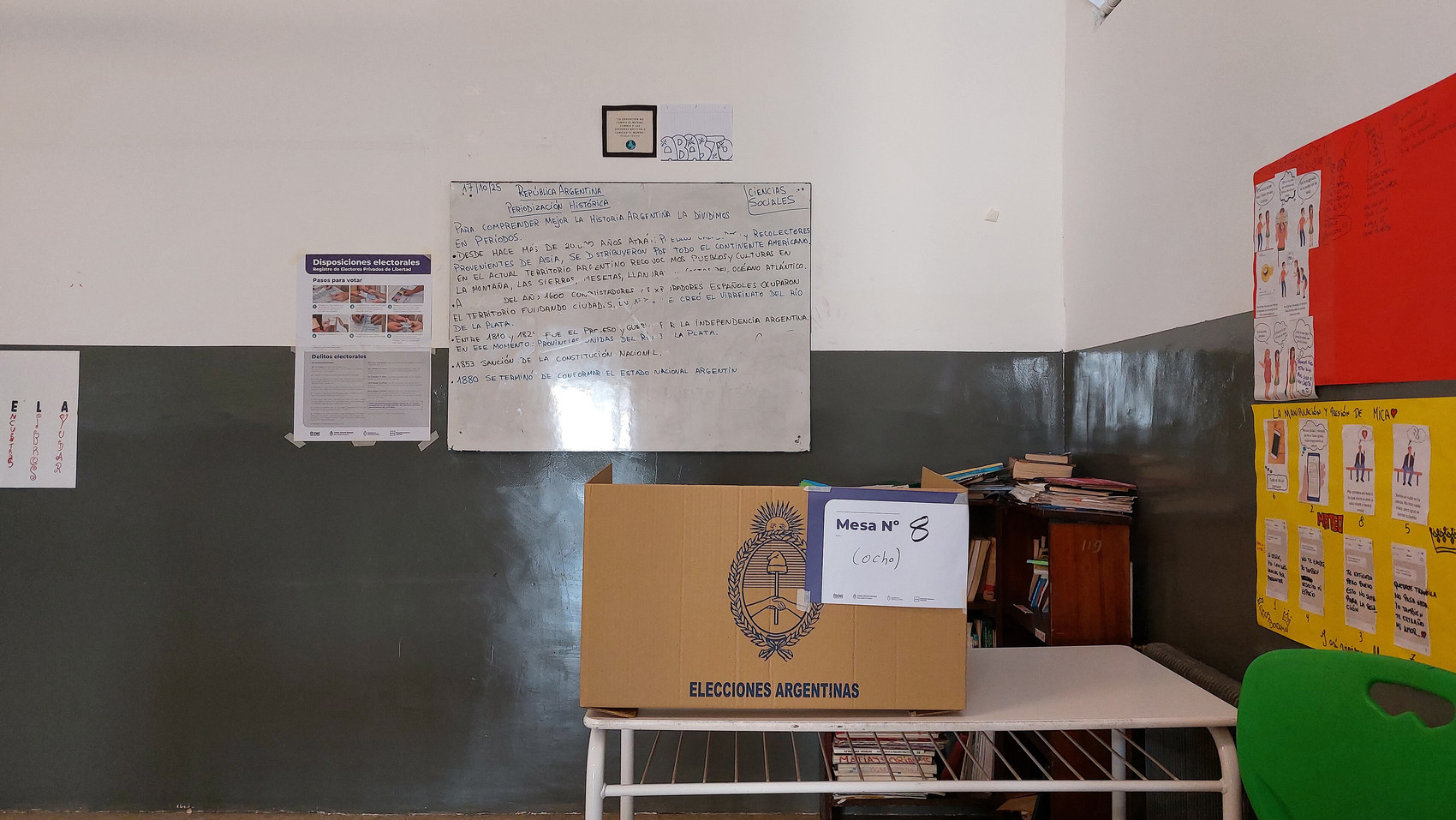
A year before Argentines vote for president on October 24, 2027, most polls put President Milei’s party and Peronism, the main opposition movement, within a few points of each other, with many voters undecided.
What the polls say
The most recent poll, from the University of San Andrés, surveyed 1,000 adults from Oct. 5–13 and put Milei’s La Libertad Avanza at 26%, up about two points since June, and Peronism at 24%. The gap is inside the poll’s credibility interval of about three points, and about a quarter of respondents were undecided or did not answer.
Polls that ask about candidates rather than parties measure something different. Zentrix, in an online survey of 1,438 people from Sept. 22–30, found Milei about a point ahead of Buenos Aires Province Governor Axel Kicillof among people certain to vote for them, but a pool of people who might still vote for Kicillof more than twice as large as Milei’s. Equipo Mide, which surveyed 2,114 people from Sept. 18–25 with a margin of error of about two points, had Milei six points ahead of Kicillof, a lead beyond its margin.
A third kind of question asks which outcome people want. In an online poll by QSocial of 1,650 people in September, 37% wanted a Peronist victory in 2027 and 28% wanted Milei re-elected, while about a quarter preferred a new political force.
The rules
The Constitution sets two rounds. A ticket, a presidential and vice-presidential pair, wins outright in the first round, on October 24, 2027, with more than 45% of the votes cast for candidates, or with at least 40% and a lead of more than ten points over the runner-up. Otherwise the top two tickets meet in a runoff, known as the balotaje, within thirty days.
The party primaries, known as PASO, are open, simultaneous and compulsory contests that choose each party’s candidates. By law they fall on the second Sunday of August in an election year, so August 8, 2027, but Congress suspended them for 2025 and the government wants to scrap or suspend them again. Changing electoral law takes an absolute majority of each chamber, which is 37 senators in the Senate, and the government has so far fallen short of that count. Senator Patricia Bullrich, who leads the ruling party’s senators, says it must pass by the end of December because electoral rules are not changed in an election year.
What could move the numbers
Milei, who has said he will seek re-election, has 36% approval against 60% disapproval in the San Andrés poll, unchanged from the month before, and far more respondents said their own finances had worsened than improved. INDEC, the national statistics agency, reported that monthly inflation picked up in September but stayed under 2%, that August activity was below its level of a year earlier and that poverty rose in the first half of the year.
Peronism, the movement built around Juan Perón, is divided between Kicillof, who says his movement is working to beat Milei, former economy minister Sergio Massa and the camp of ex-president Cristina Kirchner. Sergio Uñac, a former San Juan governor, and Juan Grabois, a social-movement leader, have also declared. Kirchner is serving a six-year sentence under house arrest and is barred for life from public office; her allies have taken the ban to the United Nations. Kicillof, Massa and her son Máximo Kirchner, rivals inside the movement, all oppose scrapping the primaries.
On the center-right, the PRO, the party of former president Mauricio Macri, has a declared hopeful in Hernán Lacunza, a former finance minister, who rules out an alliance with Milei’s party and wants the primaries kept. The PRO and Provincias Unidas, a front of provincial governors, were each in single digits in the San Andrés poll.
How it could play out
Most poll shares above count undecided respondents in the total, so they cannot be read directly against the first-round thresholds. If no ticket clears them, the top two meet in the runoff, where the votes of people who back neither, including those who want a new political force, would decide it.
A divided field could change who reaches the runoff. If the primaries disappear, Peronism could enter with several candidates, which a figure close to Kicillof said would amount to giving away the election unless it unites, and the center-right could divide the vote with Milei’s party. Lacunza has argued that 2023 was a contest of roughly three equal camps.
The Senate vote on the primaries comes first. Bullrich wants it by December, while some senators expect it to slip into early next year.