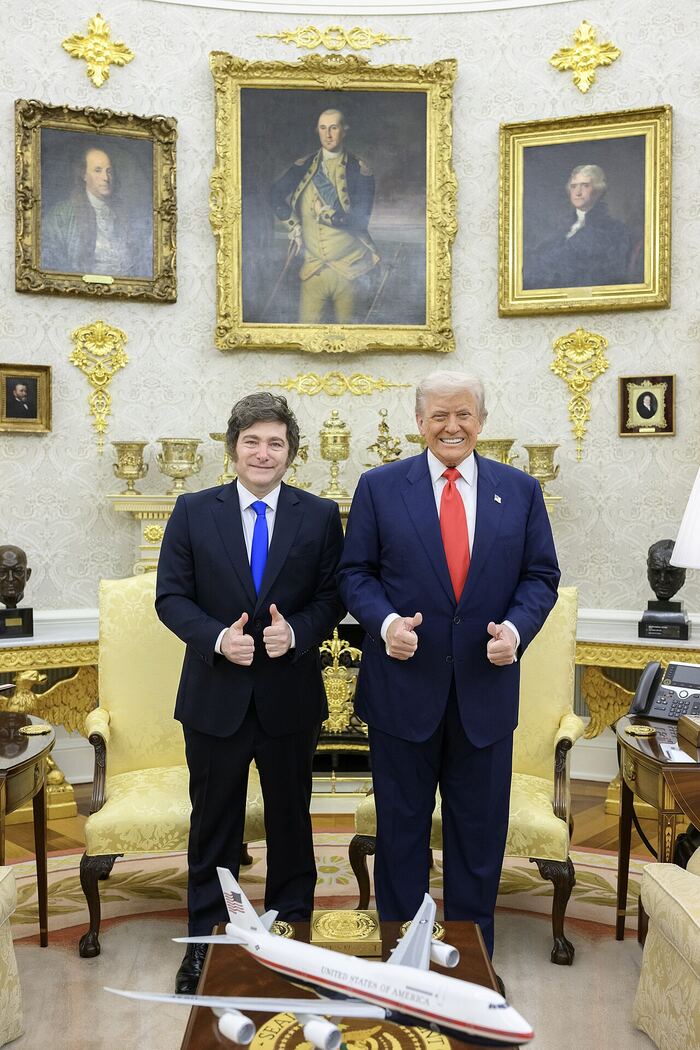
President Milei is traveling to the United Nations General Assembly in New York later this month with a specific diplomatic target in mind: a face-to-face meeting with President Trump to press Argentina's claim over the Malvinas (Falkland Islands).
The push builds directly on remarks Trump made in Dublin earlier this month, when he called a potential conflict over the islands a "disaster" and suggested he could help settle the dispute between Argentina and the United Kingdom. Those comments, a marked departure from Washington's traditionally neutral-to-pro-British posture on the sovereignty question, gave Argentina's government an opening it has been trying to widen ever since.
According to Argentine officials, the Foreign Ministry under Chancellor Pablo Quirno is working diplomatic channels to arrange a formal, separate sit-down with Trump around September 21 or 22, when both leaders will be in New York for the Assembly's high-level week. Nothing is confirmed. Even if a dedicated meeting doesn't materialize, the two presidents are set to cross paths regardless at a September 22 reception that will bring together every attending head of state, giving Milei at least some opportunity for direct contact.
Milei's stated aim for any meeting is straightforward: describe what his government calls Argentina's historical rights over the islands directly to Trump, and use the encounter to gauge how far the US president is actually willing to go. Trump himself has left the door open in vague but suggestive terms, telling reporters he is open to revisiting the US position entirely. "I always review all positions," he said. "Can I change my position? Yes, I can."
The remark, however noncommittal, has been enough to reshape the diplomatic conversation around a dispute that had been largely frozen for decades. Milei's government has spent the weeks since Trump's Dublin comments escalating pressure on the economic front, sanctioning dozens of companies and individuals tied to hydrocarbon activity near the islands and pushing oilfield service giants to choose between Falklands-area work and access to the far larger Vaca Muerta shale play.
Not everyone in Argentina's own diplomatic corps is convinced the opening is as solid as the government's public messaging suggests. One official involved in the strategy, speaking to iProfesional, voiced concern that Trump's comments are less a genuine shift in US policy than a bargaining chip in his own dealings with British Prime Minister Andy Burnham, and that the perceived opening "could dissolve" if Trump and Burnham reach an understanding that leaves Argentina out of the conversation entirely.
That caution is well founded. Any real US mediation would require London's cooperation, and Burnham has been unambiguous in ruling out any compromise on the islanders' right to self-determination, the same principle Milei has publicly dismissed as unworkable given the islands' small, largely British-descended population. A Trump-brokered settlement that Britain refuses to negotiate is not a settlement at all, whatever Trump himself says he is open to discussing.
The stakes of a possible meeting go beyond symbolism. Washington's position on the Malvinas has functioned for decades as a quiet but important variable in the dispute: US neutrality, tilting in practice toward Britain as a NATO ally, has long been one of the structural reasons Argentina's sovereignty claim never gained real traction beyond rhetorical support from the UN General Assembly and Latin American blocs. Even a modest, informal signal from Trump that Washington views the matter as open to discussion would be more than Argentina has secured from any US administration since the 1982 war, regardless of whether it translates into any actual policy change.
Milei's UN trip is also unfolding alongside a separate, unrelated international push by his domestic opposition: allies of Cristina Fernandez de Kirchner have been pursuing their own case before a different UN body, the Human Rights Committee in Geneva, seeking to overturn the lifetime ban that keeps her off the 2027 presidential ballot. The two efforts have nothing to do with one another procedurally, but both reflect the same pattern in Argentine politics this year, in which the biggest fights over the country's institutions and its foreign claims are increasingly being waged on international rather than domestic terrain.
What happens next depends less on what Trump says in New York than on whether Argentina can convert a friendly aside into an actual position with follow-through, at a moment when Washington's attention is drawn in a dozen other directions. A confirmed bilateral, or even a substantive exchange at the sidelines of the reception, would give Milei a genuine talking point heading into an election cycle where the Malvinas claim has become a central pillar of his political messaging. A meeting that fails to materialize, or one that produces only pleasantries, would leave Argentina's strategy resting on the same ambiguous opening it has been working with since early September.