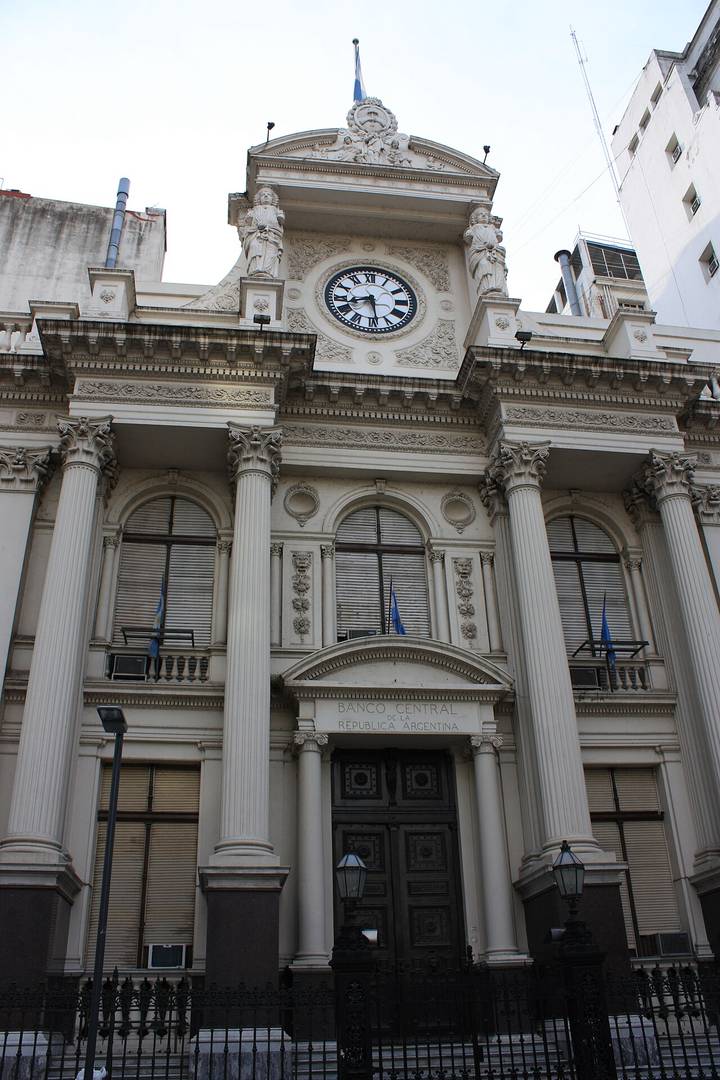
Argentina's country risk index closed at 578 basis points on Thursday, its highest level since late April, as the official dollar hit a record 1,540 pesos and the government drew down its own reserves to make an $800 million payment to the International Monetary Fund.
The JP Morgan gauge, which measures the extra yield investors demand to hold Argentine bonds over U.S. Treasuries, has climbed more than 11% this month alone, extending a run that had already pushed it to a five-month high earlier in the week. The S&P Merval fell 1% on Thursday to its lowest level since August 21, a fourth straight losing session, while sovereign bonds slipped another 0.5% on average. "Argentine sovereign bonds deepened their underperformance relative to the broader market, with renewed pressure concentrated in the long end of the curve," analysts at Adcap said. IOL Inversiones pointed partly to conditions abroad, describing "a day of pronounced risk aversion, in which rising U.S. interest rates pressured technology stocks on Wall Street and punished emerging-market assets."
The IMF Payment
Friday's $800 million payment covers principal owed to the Fund and was financed out of dollar deposits the Treasury keeps at the Central Bank, which stood at roughly $2.23 billion as of September 22. Officials plan to rebuild that cushion with a pending $1 billion disbursement, contingent on approval of the IMF's third review of Argentina's program, whose technical mission arrived in Buenos Aires on Monday. Martín Mazza of MM Investment said sustained relief for Argentine bonds still depends on "reserve accumulation, refinancing capacity, and reduced uncertainty surrounding the dollars needed for debt service," none of which this week's data resolved.
A Costlier Bond
The rising country risk is already showing up in the price of new debt. San Juan province closed its own $600 million international bond on Wednesday, financing mining-linked infrastructure, but had to pay a rate close to 10% annually rather than the roughly 9% it had initially guided, a premium bankers tied directly to the week's selloff. The province is one of several provincial and corporate borrowers the Central Bank has been counting on to bring fresh dollars into the exchange market without new sovereign borrowing.
Weak Growth, Rising Prices
The market moves compounded a soft patch in the real economy. INDEC's monthly economic activity index fell 2.9% in July from June, and was down 1.4% from a year earlier, the weakest reading since March 2025. The decline was broad, touching 8 of 15 sectors: commerce fell 5.1% year-on-year, manufacturing 4.6%, construction 3.3% and financial intermediation 3%, with gains in mining and agriculture too small to offset them.
Food prices are also creeping back up. The consultancy LCG found food and beverage prices rose 1.7% in the fourth week of September alone, bringing the four-week increase to 2.7%, with what the firm described as a marked rise in the number of products showing increases. Overall inflation has held near 1.7% a month since August's reading came in at that same pace, the slowest in 14 months, but analysts say the pickup in food costs makes a further deceleration this year less likely.
The combination leaves Milei's government in an uncomfortable spot heading into the final stretch before 2027's midterm elections: the disinflation narrative it has built its economic program around remains intact on paper, but weaker activity, pricier provincial debt and a country risk level not seen since April all suggest the underlying picture is harder to sell than the headline inflation number alone.