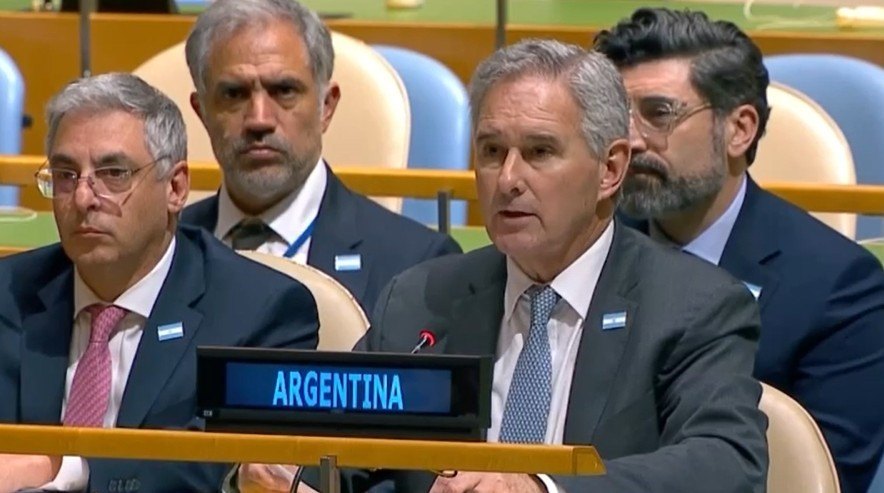
Argentine Foreign Minister Pablo Quirno used Argentina's right of reply at the United Nations General Assembly on Tuesday to tell the chamber that the United Kingdom "illegally" occupies the Malvinas (Falkland Islands) and to renew Argentina's call for sovereignty negotiations, hours after British Prime Minister Andy Burnham vowed London would remain "firm" in defending the islands' right to stay British.
Burnham told the Assembly the UK would "be firm against any threat and challenge to the rule of law... when they threaten the rights of British territories to remain British, as is the case with the Falkland Islands," adding that Britain would keep building its "hard power" and deterrence but would not "play Russia's game."
It was the second time this month Burnham has publicly taken on Milei over the islands. On September 9, he told Parliament Britain would be "relentless" in defending the islanders after Milei said they had no legitimate right to self-determination. Taking the argument to the General Assembly floor moves the dispute from the two capitals to the UN body whose resolutions Argentina has long relied on.
Quirno requested speaking time to respond, telling the Assembly that the Malvinas, South Georgia, the South Sandwich Islands and their surrounding maritime spaces "are an integral part of Argentine national territory," and describing British control since January 1833 as an "illegal occupation." He called for an end to unilateral decisions -- specifically petroleum exploitation in the North Basin near the islands -- and demanded a resumption of bilateral negotiations under UN General Assembly Resolution 31/49, which calls on both countries to avoid unilateral changes while the dispute is unresolved.
"By history and by right, the Malvinas (Falkland Islands) are Argentine," Quirno said, closing his remarks.
The Oil Fight Behind It
The North Basin reference points to the oil fight that has driven the escalation. Argentina has sanctioned dozens of companies and individuals tied to oil work near the islands, a federal court in Tierra del Fuego ordered a halt to the Sea Lion oilfield pending an environmental review, and Milei has sent Congress a bill adding criminal penalties for companies operating there. London has called the legal action against those firms "unacceptable", and the UN Special Committee on Decolonization renewed its call in June for the two governments to negotiate.
Washington remains the wild card. Trump said this month he could personally "settle" the dispute, but Quirno said days before the Assembly opened that Argentina was not counting on US mediation to resolve it. Burnham, for his part, used his first meeting with Trump this week to tell him directly that Britain will "stand firm."
Milei Takes the Floor
Milei took the same stage on Wednesday and made the dispute a centerpiece of his third address to the Assembly. "Malvinas is for us a national cause," he said, accusing the UN of having "decided to look the other way" on the islands. "What use is a resolution if, for decades, the other party can act to the contrary?" he asked, citing Resolution 31/49.
He singled out the Sea Lion project, which he said "advances toward oil extraction in Malvinas under British licenses that Argentina rejects as illegal and illegitimate," and said his government had traded "a discursive defense" for "a peaceful, practical and effective" one. "In the face of illegitimate exploitation, we act: we filed warning notes, we sanctioned the companies involved," he said, while repeating Argentina's call for bilateral negotiations with Britain.
The back-to-back exchanges underscore how far apart London and Buenos Aires remain: both governments have hardened their public positions in recent weeks, with Argentina widening its legal and financial pressure on firms operating near the islands and Britain rejecting any suggestion that its sovereignty claim is open to renegotiation.