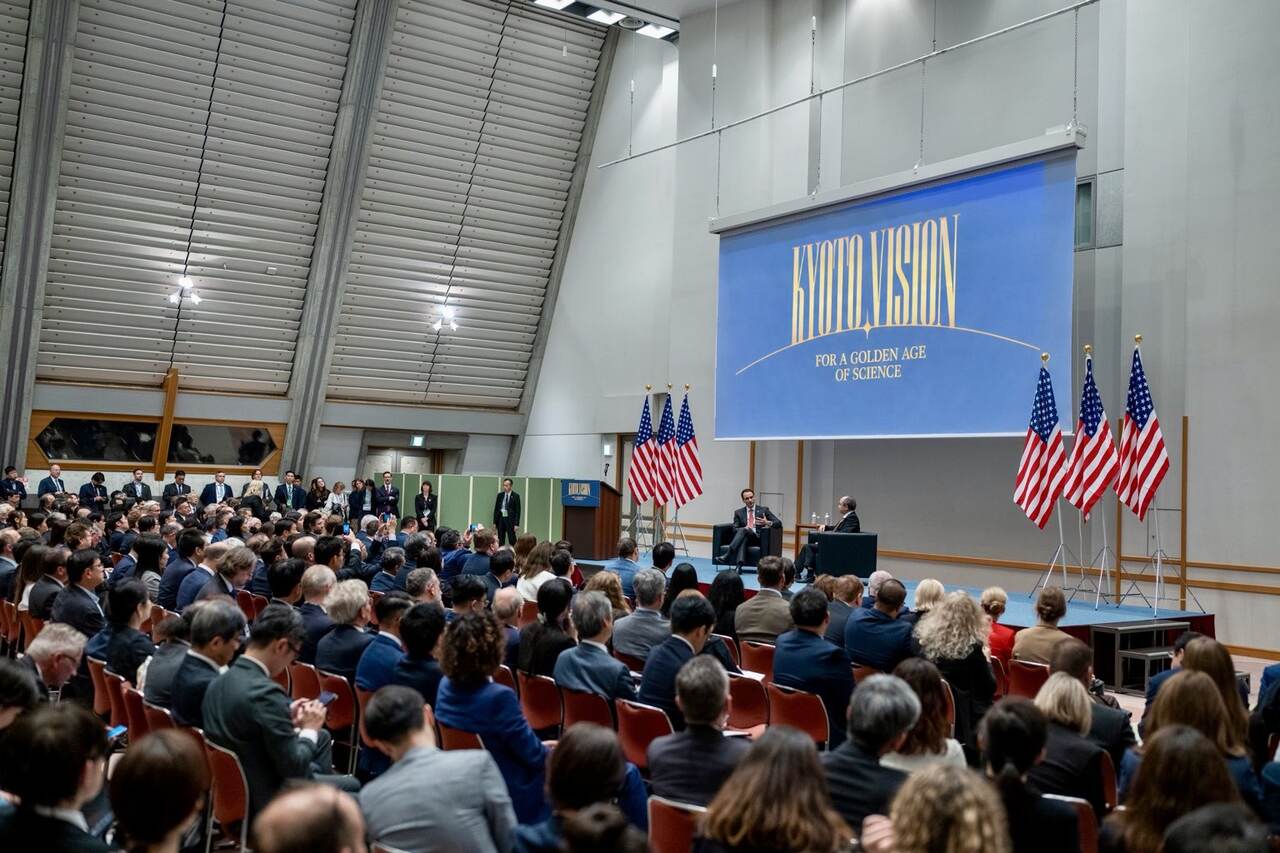
Argentina on Sunday endorsed the Kyoto Vision for a Golden Age of Science, a joint statement led by the United States that backs wider use of advanced artificial intelligence in scientific research. Seventeen countries, the US among them, endorsed it.
The statement was released at the Science and Technology in Society Forum in Kyoto, Japan, and led by Michael Kratsios, director of the White House Office of Science and Technology Policy. It is a declaration of principles, not a treaty. Besides the US and Argentina, the countries are Bulgaria, Chile, Cyprus, Germany, Greece, Indonesia, Italy, Japan, Kazakhstan, South Korea, New Zealand, Poland, Singapore, the United Arab Emirates and the United Kingdom.
The text calls for three things: better ways of funding and organizing research, such as long-duration awards, rapid grants and prizes; the use of what it calls "super intelligence", the Trump administration's term for advanced AI, in scientific work; and support for early-career talent. Its commitments are worded softly: the ministers say they "endeavor to expand access" to AI tools, scientific data, computing infrastructure and experimental facilities, and "encourage" the rest.
For Argentina, the practical effect looks diplomatic: it puts the country on a US-led list of partners on AI policy, which fits the Milei government's push to attract AI investment with light regulation and cheap energy for data centers. The text itself carries no money, computing capacity or data-center projects. Argentina ranked last among 28 economies in a Goldman Sachs study of AI adoption, and the data-center push has drawn objections over its cost to Patagonia.
Kratsios called the Kyoto Vision "a call to action" and said "the world is ready to move forward with us." The statement follows the White House science office's July report on overhauling US science funding. The administration's proposed 2027 budget, meanwhile, would cut National Science Foundation funding by about half, NBC News reported.