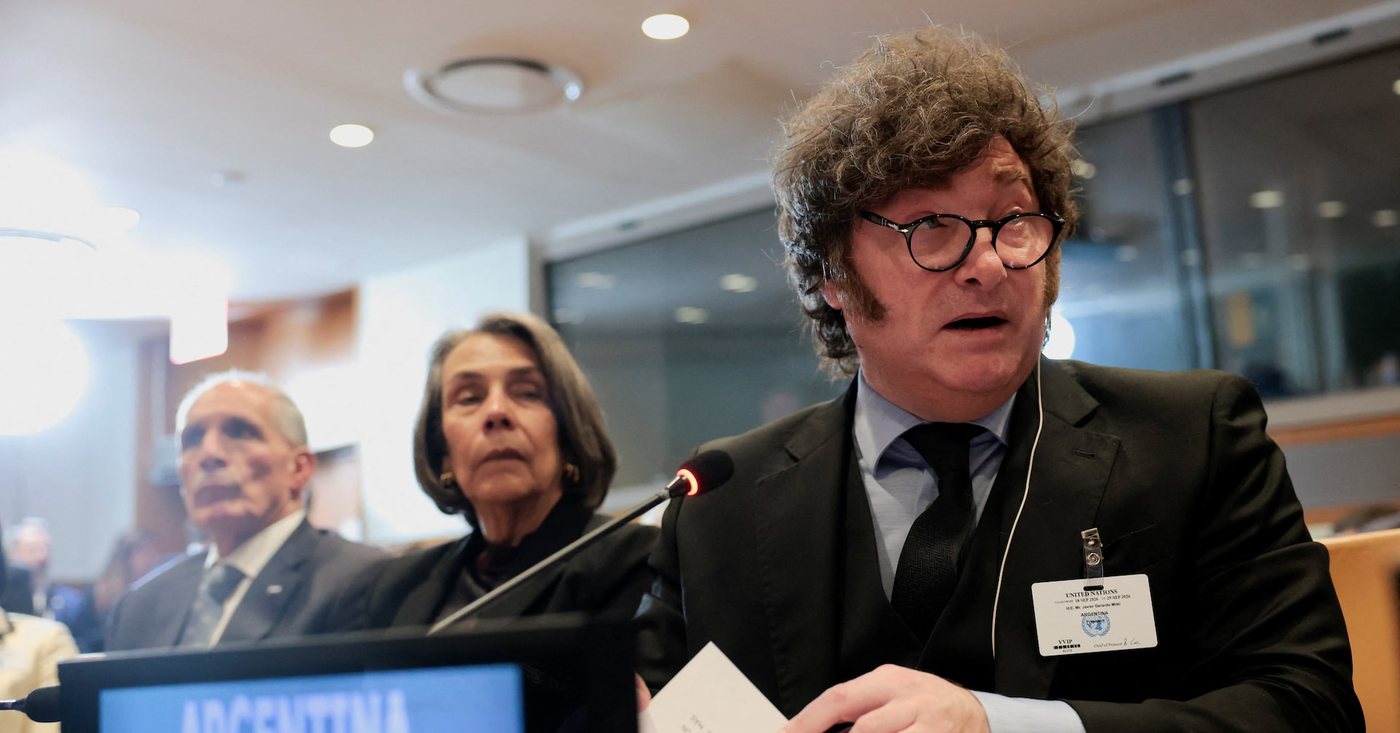
Milei told the United Nations General Assembly on Wednesday that the body had become "a useless organization that only serves to feed a caste of parasites," using his third address to the chamber to accuse it of failing Argentina on the Malvinas (Falkland Islands), to warn oil investors away from the islands and to restate his alignment with the United States and Israel.
Britain answered within hours. The UK Mission to the UN posted a written statement for the Assembly's official record declaring that London "has no doubt about its sovereignty" over the islands, calling Argentina's sanctions on oil companies "wholly unacceptable" and saying Argentina's conduct "is not the behaviour we expect of a democracy."
The Malvinas Claim
"Malvinas is a national cause for us," Milei said, a line he repeated twice. He charged that an organization created to protect the territorial integrity of its members "decided to look the other way" on the islands, and pointed to Resolution 31/49, adopted by the Assembly 50 years ago, which calls on Argentina and Britain to avoid unilateral changes while the sovereignty dispute remains unresolved.
Britain has kept acting against that resolution, he argued, singling out the Sea Lion oil project north of the islands, which he said "advances toward the extraction of oil on the Argentine continental shelf" under British licenses that Argentina "rejects as illegal." Instead of what he called a merely rhetorical defense, Milei said his government had chosen a "peaceful, practical and effective" one.
He listed the steps. "We sanctioned the companies involved and their suppliers," he said, referring to the sanctions list Argentina has built up this month, and his government has sent Congress a National Sovereignty Defense bill. A federal judge in Tierra del Fuego ordered a halt to the project last week.
The speech came a day after Foreign Minister Pablo Quirno used Argentina's right of reply to tell the Assembly that Britain "illegally" occupies the islands, and after British Prime Minister Andy Burnham raised the islands directly with President Trump in their first meeting.
Milei rejected the islanders' claim to self-determination outright. The islanders, he said, are "a population implanted by the occupying power," and the principle exists "to liberate colonized peoples, not to consecrate situations derived from colonization." He repeated Argentina's call on Britain to resume sovereignty negotiations.
He closed the section with a message to the energy industry. Milei invited investors to Vaca Muerta, Argentina's shale formation, but warned that "this invitation has a limit. We will not be indifferent to those who exploit resources under illegal foreign occupation."
London Answers
The British reply was posted by the UK Mission in New York on Wednesday afternoon as a statement the United Kingdom asked to be placed "in the official record of proceedings" of the Assembly's general debate. It answered Milei point by point.
The United Kingdom has no doubt about its sovereignty over the Falkland Islands. Our statement in response to the Argentine General Assembly Statement regarding the Falklands.
On sovereignty, it said the UK "has no doubt" about its sovereignty over the islands, South Georgia and the South Sandwich Islands "and the surrounding maritime areas of both territories," and that the islanders' right of self-determination is set out in the UN Charter and in Article 1 of the two UN human rights covenants. "The Falkland Islanders have as much right to determine their political status and freely pursue their economic, social and cultural development as any other peoples," it said.
It took on Argentina's legal case directly. UN resolutions and regional declarations calling for negotiations "do not modify or dilute the obligation of nations to respect the legally binding right of self-determination," the statement said, adding that Resolution 2065 and Resolution 31/49, the text Milei had cited hours earlier, do not limit the islanders' right to decide their own status or develop their economy.
On oil, London called hydrocarbon development "a legitimate commercial venture" regulated by the Falkland Islands Government "in strict accordance with the United Nations Convention on the Law of the Sea," and added a line aimed squarely at the court order and the sanctions: "Argentine domestic law does not apply to the Falkland Islands." Efforts to "obstruct and harass" companies working in the islands' oil sector and other industries, it said, are "a wholly unacceptable attempt to exercise extra-territorial jurisdiction" that are "obstructive to global business and inconsistent with free trade" -- an unusual charge to level at a government that has made open markets its calling card.
The sharpest passage was political. Argentina "continues to deny that this fundamental human right applies to the people of the Falkland Islands, and actively seeks opportunities in international fora to assert its sovereignty claim," the statement said. "This behaviour is wholly incompatible with the principles established in the United Nations Charter and is not the behaviour we expect of a democracy."
It ended by closing the door Milei and Quirno had tried to open. Citing the 2013 referendum, in which 99.8 percent of islanders voted on a 92 percent turnout to remain a British overseas territory, it said: "There can be no dialogue on sovereignty unless the Falkland Islanders so wish."
Britain regularly answers Argentina's Malvinas remarks at the Assembly with a written statement for the record, but this year's went further than a restatement of position, naming Argentina's sanctions and legal actions and questioning its democratic conduct.
Beyond the Islands
Milei framed the rest of the speech around three failings he attributed to the UN: what it should have done and did not, what it should not have done and did, and how it is approaching artificial intelligence.
He said Argentina "aligns itself unambiguously with the West," naming the United States and Israel. He repudiated what he called the Iranian regime's attacks on Israel, noted that his government has declared Iran's Revolutionary Guard a terrorist organization, and said Argentina is still seeking justice for the 1992 bombing of the Israeli embassy and the 1994 attack on the AMIA Jewish community center in Buenos Aires.
His harshest words were reserved for the pandemic. Milei called lockdown policies promoted by UN agencies "a global experiment in social control disguised as science" that "destroyed jobs," described their human cost with a single word, "genocide," and cited the experience as the reason Argentina decided to leave the World Health Organization.
On artificial intelligence, he argued against state control of the technology, saying fear "should under no circumstances automatically become obedience" and offering his own answer: "In the face of fear, courage." He compared AI to a 21st-century version of Adam Smith's pin factory, a leap in productivity rather than a threat to jobs, and said that granting governments control over innovation hands some people "the power to limit what others can create." He pitched Argentina as a destination for AI development, with light regulation and tax incentives.
Milei also said Argentina is rebuilding its armed forces "after decades" of neglect and acknowledged the country's own record: "For a century we tried almost every way of preventing our own greatness." He closed with an appeal to investors and talent to "look south" toward Argentina's farmland, oil and minerals, describing the country he wants as "a free nation, a prosperous nation, a sovereign nation," before ending with his trademark "Long live freedom, damn it!"
What It Leaves Open
Milei arrived in New York hoping to secure a one-on-one meeting with President Trump, but left the Assembly floor without one, having met Secretary of State Marco Rubio instead. Burnham got his meeting with Trump, and used it to raise the islands.
The exchange leaves both governments further apart than when the week began. Argentina is pressing its claim through sanctions, the courts and Congress, where the sovereignty bill is only beginning its path, while London has now said on the UN record that Argentine law has no reach in the islands and that talks depend on the islanders. For the companies behind Sea Lion, the question is which of those two positions carries more weight in practice.