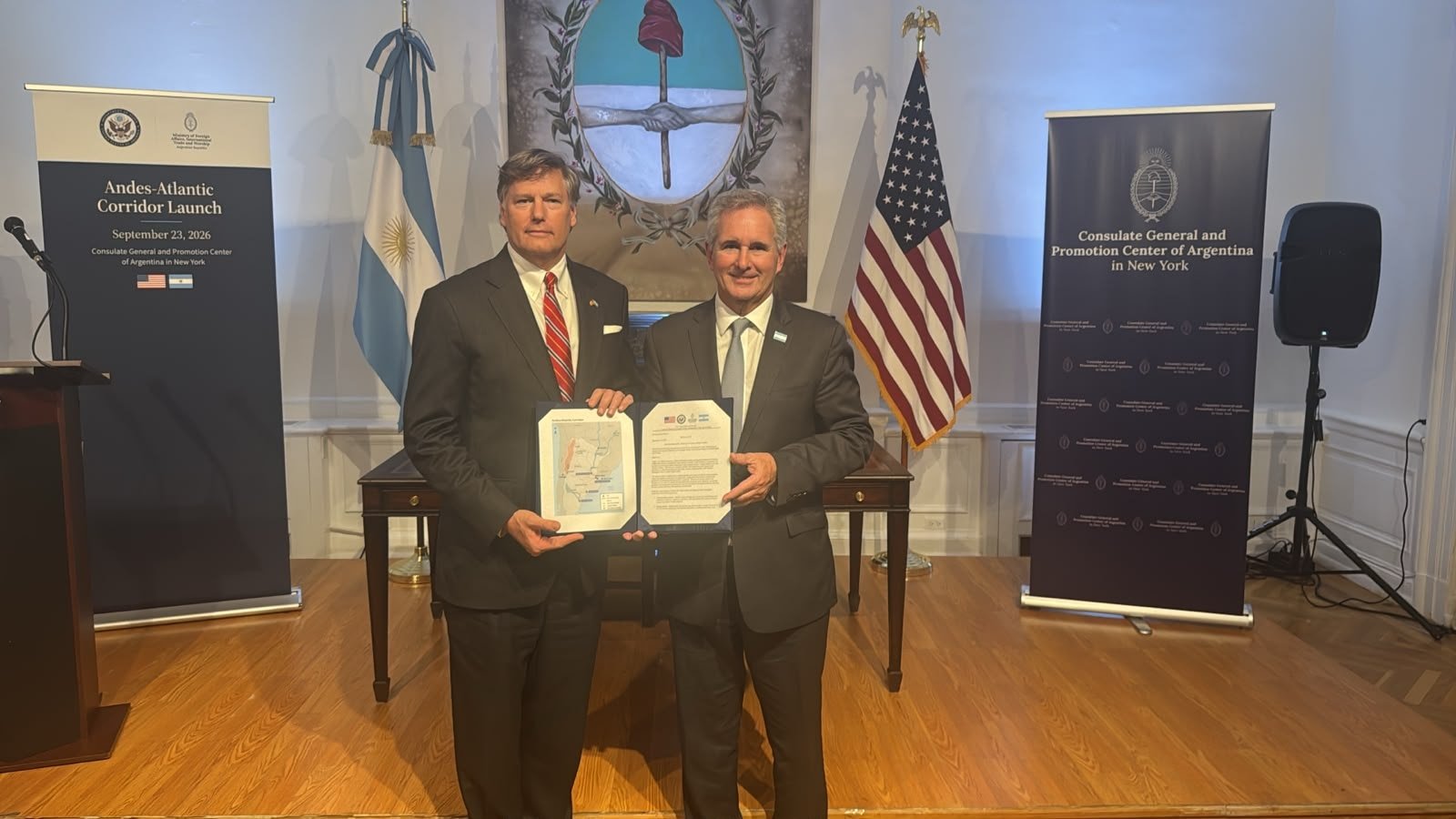
Argentina and the United States on Wednesday launched a joint infrastructure investment framework worth up to $7 billion through 2027, naming it the "Andes-Atlantic Corridor" and billing it as the first such corridor Washington has set up in the Western Hemisphere.
El compromiso del presidente Trump y el liderazgo del presidente Milei se traducen hoy en algo concreto: Estados Unidos y Argentina lanzaron el Corredor Andes-Atlántico, la iniciativa que conectará la matriz productiva argentina con los mercados de Occidente a través de inversión de EE. UU. 🇺🇸🇦🇷
Translation: "President Trump's commitment and President Milei's leadership translate today into something concrete: the United States and Argentina launched the Andes-Atlantic Corridor, the initiative that will connect Argentina's productive base to Western markets through U.S. investment."
The framework, called the U.S.-Argentina Build the Future Framework, was presented at a ceremony at Argentina's consulate in New York. Foreign Minister Pablo Quirno and Economy Minister Luis Caputo represented Argentina; U.S. Under Secretary of State Christopher Landau led the American delegation, joined by Ambassador to Argentina Peter Lamelas and officials from the Export-Import Bank and the Development Finance Corporation. "The United States will allocate up to $7 billion for critical minerals and energy in Argentina," Lamelas said, adding that the money would "support mutually beneficial projects and secure, strategic energy supply chains."
Where the Money Goes
Of the roughly $7 billion, about $6 billion is tied to financing for the Argentina LNG project, the YPF-led venture with Italy's Eni and the UAE's XRG that aims to export Vaca Muerta shale gas from floating liquefaction units off Río Negro. The Export-Import Bank has put forward a non-binding proposal for that portion, with the Development Finance Corporation and private American lenders expected to join in. This builds on the financing package Quirno and Landau were expected to present in New York earlier in the week, now folded into the broader corridor framework and given its formal name. The remaining roughly $1 billion is earmarked across the corridor's other projects, though it has not yet been allocated line by line.
The corridor's declared scope goes well beyond gas. Officials listed gas and oil pipelines and a new high-voltage transmission line into the Buenos Aires metropolitan area; rail projects including the possible privatization of the Belgrano Cargas freight line and a proposed link between Vaca Muerta and the port of Bahía Blanca; port upgrades and the Paraná waterway; lithium and copper mining and processing; and an expansion of fiber-optic and submarine-cable telecommunications through the state carrier ARSAT.
The Strategic Backdrop
Washington described the corridor as its first in the Western Hemisphere, modeled on similar U.S.-backed infrastructure initiatives already running in Africa and the Philippines. American officials framed the push explicitly around competition for critical minerals and energy supply chains, at a moment when Middle East tensions have added to concerns about global energy security, and pointedly said the framework would favor partners operating within market rules, an implicit reference to Chinese investment in the region's mining and infrastructure. Argentina, for its part, is betting the deal will reinforce the legal protections and tax incentives under its RIGI investment regime, the framework the government has used to court large-scale projects such as the $51 billion Vaca Muerta LNG project at Punta Colorada.
A U.S. delegation led by Landau is due in Argentina in October, with stops planned in Buenos Aires, Jujuy and Salta to identify specific projects for financing. The framework itself is meant to be completed by the end of 2027, meaning Wednesday's launch marks the start of a negotiation over specific loans, guarantees and contracts rather than a finished agreement. The real test of the corridor will be how much of the $7 billion actually gets disbursed, and on what terms, over the next year.