Argentina's government has asked the United States to renegotiate the bilateral trade agreement the two countries signed in February, after concluding it lacks the votes in Congress to ratify it, only for Washington to reject reopening the deal, Bloomberg reported this week.
The Agreement on Reciprocal Trade and Investment, known by its Spanish acronym ARTI, was signed on February 5 and promised to eliminate U.S. tariffs on roughly 1,675 categories of Argentine goods, cutting duties to zero on pharmaceuticals, machinery, computer equipment and other products, while creating duty-free quotas for beef, automobiles and cheese. In exchange, Argentina committed to a set of regulatory changes, including joining an international patent treaty and adopting new rules on data and technology. But the deal takes effect only once both countries complete their own ratification procedures, and Argentina's side of that process has not moved.
Why Argentina Wants a Do-Over
Two problems are colliding. President Milei's Chamber of Deputies bloc, La Libertad Avanza, holds just 95 of 257 seats and 20 of 72 in the Senate, both far short of a majority, leaving the government dependent on coalition partners Provincias Unidas and PRO for any vote it wants to win. Congress's ordinary session ends in November, and the calendar is already crowded with the 2027 budget, a labor reform bill, a new companies law and changes to electoral rules.
The second problem is legal. The tariff cuts at the heart of ARTI relied on presidential authority under the U.S. International Emergency Economic Powers Act, the same authority the U.S. Supreme Court struck down in February, weeks after the deal was signed. With that legal foundation gone, Argentine officials are now seeking other concessions, including relief from the 50% tariffs the U.S. still applies to steel and aluminum under a separate national-security statute, to make up for the tariff cuts the ruling put in doubt.
Brazil has separately objected to the deal on different grounds. It argued in March that Argentina's bilateral tariff cuts to the U.S. break Mercosur rules requiring the bloc to negotiate with outside countries jointly rather than one member at a time, an objection Foreign Minister Mauro Vieira repeated at a June summit, though Brazil has not filed a formal dispute.
Washington Says No
U.S. Trade Representative Jamieson Greer has said the administration intends to stand by the agreements it signed despite the Supreme Court ruling. "These agreements will be good. We will back them. We expect our partners to respect them," he said, adding that he had not "heard anyone tell me the agreement is cancelled." Other U.S. officials were more blunt about renegotiation itself, telling Bloomberg that reopening ARTI "is not viable, since it would set a precedent" other countries with stalled deals of their own could then demand for themselves.
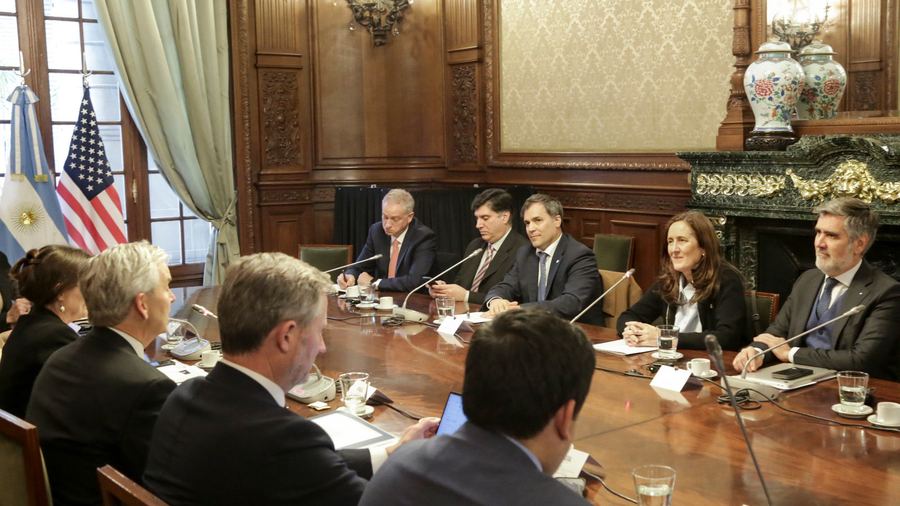
Deputy U.S. Trade Representative Jeffrey Goettman traveled to Buenos Aires on August 27 to press the point in person, meeting Argentina's Secretary of Innovation, Science and Technology, Adriana Baravalle, and Ambassador Fernando Brun at the Palacio San Martín. U.S. officials tied further American investment, including financing for mining projects under the countries' broader infrastructure framework, to three conditions: ratifying ARTI, advancing Argentina's rules on "trustworthy" technology, and joining the Patent Cooperation Treaty. "Our hope is that Argentina can ratify the ARTI," the U.S. Embassy's deputy chief of mission, Heidi Gomez Rapalo, said, linking ratification directly to investor confidence.
The Patent Fight at Home
One piece of that checklist is already moving. Argentina's Chamber of Deputies voted on August 27 to join the Patent Cooperation Treaty, the international system administered by the World Intellectual Property Organization, after nearly three decades of inaction, though only after the government agreed to concessions sought by domestic pharmaceutical laboratories. The bill has since gone to the Senate, where it remains pending. Multinational drugmakers have pushed for the treaty's full commitments, while Argentine manufacturers have lobbied for a version that limits the effect on generic drug production and prices, a preview of the kind of domestic friction that has slowed the broader trade agreement.
For now, some elements of ARTI are moving forward regardless: the government can adjust specific tariffs by decree, and it has already implemented parts of the agreement, including a fivefold increase in Argentina's tariff-preferential beef quota, the same one that stood apart from a separate, temporary tariff-free beef window the U.S. opened for other countries in August, which excluded Argentina precisely because it already had a preferential quota of its own. But the treaty's full tariff relief and its patent commitments cannot take legal effect until Congress ratifies ARTI itself, and with Washington ruling out a renegotiated version and Argentina's government short of votes and time, how much of the deal's promised tariff relief actually reaches Argentine and American businesses this year now depends on a Congress that has other priorities and a government that, for now, does not have the numbers.