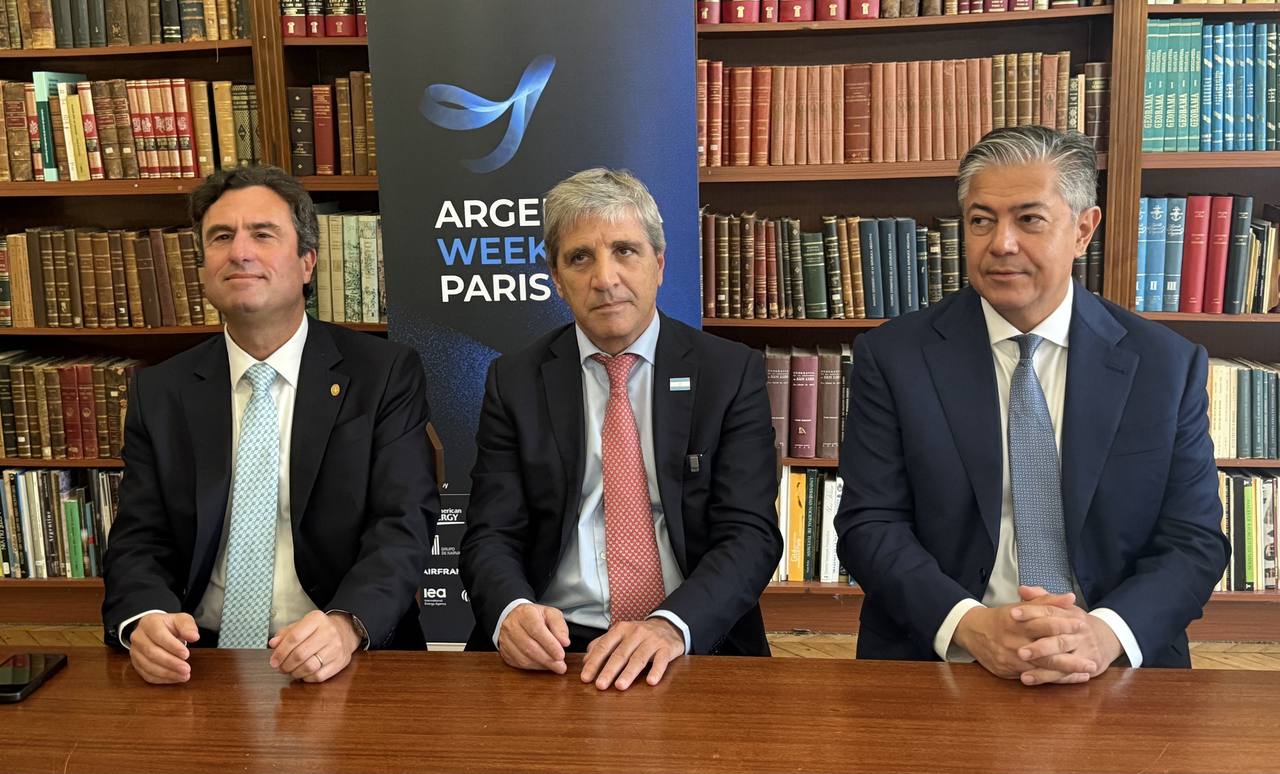
Argentina's government announced RIGI investment-incentive approvals for two large projects on Friday as Argentina Week in Paris closed: Pluspetrol's US$12.4 billion oil development in Vaca Muerta and Glencore's US$4 billion Agua Rica copper mine in Catamarca.
Economy Minister Luis Caputo announced the Pluspetrol approval in Paris, and President Milei announced Agua Rica alongside Gary Nagle, chief executive of Swiss-based Glencore. On Wednesday, Caputo had announced the same committee's approval of a US$1.34 billion Toyota plant in Zárate, in Buenos Aires province, the first carmaker project admitted to the regime. Gustavo Salinas, Toyota Argentina's chief executive, told Ámbito the approval lets the local unit take the project to the Japanese parent for a final decision. The three projects add up to about US$17.6 billion, according to the government's figures.
Nuevo RIGI aprobado 🇦🇷🇦🇷 El Comité Evaluador aprobó el ingreso RIGI del proyecto Bajo del Choique - La Invernada, impulsado por Pluspetrol y GyP. Se trata de un desarrollo no convencional en Vaca Muerta que prevé una producción de 613 millones de barriles de petróleo y 50.366 millones de m³ de gas durante la vida del proyecto, que tendrá a más del 92% de la producción destinada a la exportación.
Translation: "New RIGI approved. The Evaluation Committee approved the RIGI entry of the Bajo del Choique - La Invernada project, led by Pluspetrol and GyP. It is an unconventional development in Vaca Muerta expected to produce 613 million barrels of oil and 50.366 billion cubic meters of gas over the project's life, with more than 92% of output going to export."
Approval matters because of what the RIGI locks in. The regime, created by the 2024 Ley Bases, fixes a project's tax, customs and foreign-exchange rules for 30 years and cuts its corporate income tax to 25% from the standard 35%, according to ARCA, the federal tax agency. Pluspetrol's country manager, Julián Escuder, called that long-term predictability essential for capital-intensive shale projects. The Centro de Economía Política Argentina (CEPA), a Buenos Aires think tank that has criticized the regime, estimated in May that the projects approved by then would cost the Treasury between US$786 million and US$1.4 billion a year in forgone revenue.
The government's headline number from the three-day Paris showcase was bigger. Ian Sielecki, Argentina's ambassador in France, who ran the event, said on X that it produced US$27 billion "in investment announcements," crediting "macroeconomic seriousness and the president's global magnetism." The figure is an announcement tally, not a count of approved or committed spending, and the government did not release the full list despite reporters' requests, La Nación reported.
Todo esto fue posible gracias a dos fuerzas: la seriedad macroeconómica y el magnetismo mundial del presidente Javier Milei. US$27.000 MILLONES en anuncios de inversión. 13 gobernadores, una delegación inédita en la historia.
Translation: "All of this was possible thanks to two forces: macroeconomic seriousness and the global magnetism of President Javier Milei. US$27 BILLION in investment announcements. 13 governors, a delegation without precedent in history."
The projects Sielecki named are at very different stages. Only Pluspetrol's and Glencore's, about US$16.4 billion together, have RIGI approval. The largest other item is TotalEnergies' roughly US$10 billion plan unveiled on Thursday, spread over about a decade and partly for existing operations; its US$5 billion San Roque oil project in Vaca Muerta has not yet been submitted to the RIGI committee. Pan American Energy's US$1.2 billion bid to revive Cerro Dragón, an aging oil field in Chubut, is still under evaluation, and French miner Eramet has said only that it will seek RIGI status for a US$350 million lithium expansion in Salta.
Pluspetrol, an Argentine-founded oil company now based in the Netherlands, will develop the Bajo del Choique-La Invernada block in Neuquén with the provincial energy company GyP, which holds 10%. The company said the 25-year plan will drill more than 620 horizontal wells and lift output above 100,000 barrels of oil a day; Caputo said more than 92% of production would be exported. His post put the investment at US$12.24 billion; the company and Neuquén Governor Rolando Figueroa gave US$12.4 billion.
Agua Rica will process ore at the nearby Alumbrera plant and ship concentrate by pipeline to Tucumán and then by rail to the port of Rosario. Glencore plans to spend US$771 million in the first two years, start construction in November 2027 and begin production in October 2031, reaching about 200,000 tonnes of copper a year, all for export. Nagle told a panel at the OECD on Thursday that post-RIGI Argentina has become more competitive than its closest rivals, particularly Chile and Peru, and called the regime the key enabler for Glencore to invest US$14 billion to US$20 billion in the country over the next decade.
The approvals arrive as overall investment is shrinking. Gross fixed capital formation fell 11.1% in the second quarter from a year earlier, and GDP slipped 0.6% from the first quarter, according to INDEC, the national statistics agency. Mining and quarrying grew 16.4% from a year earlier, the same export-oriented corner of the economy where the RIGI projects are concentrated.
None of the three approvals had been published in the Boletín Oficial, the official gazette, as of Friday, and the Economy Ministry's own RIGI tally counts a project as approved only once its resolution appears there. The next tests are the Pan American Energy decision, TotalEnergies' San Roque filing and Toyota's verdict in Japan.