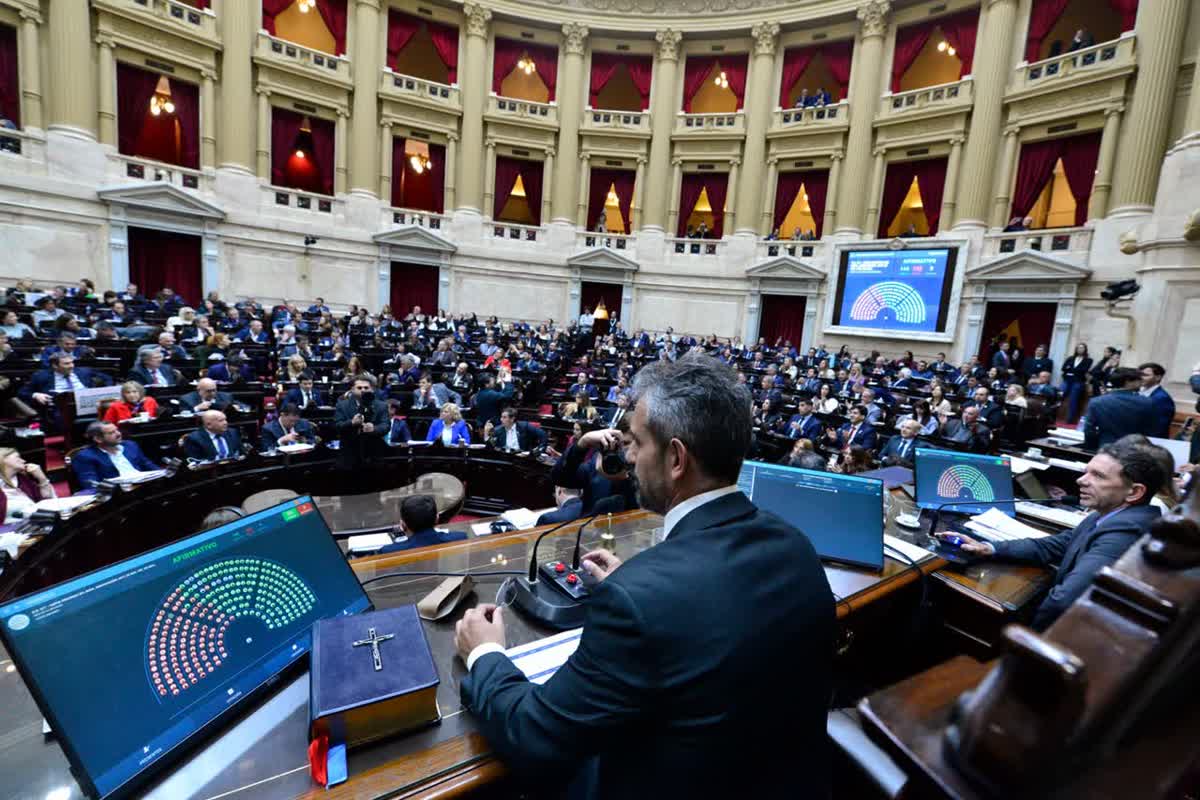
The opposition’s special session in the Chamber of Deputies to overturn President Milei’s deregulation decree (officially Decree 70/2023) collapsed on Thursday, October 15, when 121 deputies took their seats, eight short of the 129 needed for a quorum.
The deregulation decree, a decree of necessity and urgency (DNU) that Milei signed in December 2023, stays in force. Under Law 26.122, a DNU falls only when both chambers reject it. The Senate did in March 2024, but Deputies has never voted, so the session was the last step needed to strike the decree down. The opposition called it after a Supreme Court ruling revived the decree’s end to foreign land limits. Government officials had argued that a full rejection would revive the old rental law and the earlier rules on air transport, a disruption they said would unsettle investors.
Quorum in the 257-seat chamber is an absolute majority, 129. Speaker Martín Menem, of Milei’s La Libertad Avanza party, declared the session lapsed with 121 deputies present. Peronist Unión por la Patria had 90 of its members seated and Provincias Unidas, a bloc of centrist provincial lawmakers, had 10 of 18. Three deputies of Tucumán’s Independencia bloc and two of San Juan’s Producción y Trabajo stayed away, as did eight Provincias Unidas members from Santa Fe, Jujuy, Córdoba, Río Negro, Mendoza and Chubut.
The absences came from blocs tied to governors who keep a working relationship with the Casa Rosada, Milei’s government. They included Jujuy’s María Inés Zigarán, who had signed the request for the session. A Provincias Unidas colleague told Infobae she had said she would give quorum but planned to leave when the decree came up, and that a call from Governor Carlos Sadir weighed more. Not every governor’s bloc stayed away: three deputies of Elijo Catamarca and two from Salta’s Argentina Federal took seats.
A second court order, an October 9 injunction restoring the limits for now, made the opposition’s count harder, its negotiators said. The government made two moves in the 48 hours before the vote. On Wednesday, La Libertad Avanza agreed to add limits on foreign purchases of rural land to its private-property bill: Article 38 repeals the decree’s Article 154, and Article 39 restores Law 26.737, the 2011 land law that capped foreign ownership at 15%. On Thursday, it announced a meeting next week with mining companies and logistics operators on the Belgrano Cargas rail branch serving Salta’s Puna, which Governor Gustavo Sáenz had publicly demanded on Monday. Sáenz’s circle called it “an important step” while saying the “decisive step” is still missing.
Opposition lawmakers criticized the trade-offs between the Casa Rosada and the provinces. “Today there was no quorum to address family debt or to extend the disability emergency,” Deputy Pablo Juliano wrote on X. “For the benefit of the rich, quorum appears.” The session’s agenda also included an extension of the disability emergency law and a bill on household debt, and neither was debated.
Menem posted on X that the opposition “wanted to put a brake on Argentina once again and fell short,” and Milei reposted it. Menem said the decree removed bureaucratic obstacles and asked what society would have gained from repealing it. “The important thing is that Argentina does not go backward,” he said. Menem also said his party is studying how to turn parts of the decree into laws, and acknowledged it cannot reach quorum alone: “Every time we call a session we are 94 or 95. We are 34 short.”
Una vez más, quisieron ponerle un freno a la Argentina y se quedaron en el intento. El país ya eligió un rumbo y no va a retroceder para satisfacer a los que nos llevaron al fracaso.
Translation: "Once again, they wanted to put a brake on Argentina and fell short. The country has already chosen a direction and will not go backward to satisfy those who led us to failure."
La Libertad Avanza has called its own session for noon on Wednesday, October 21, led by its floor leader Gabriel Bornoroni. The agenda covers the private-property bill with the land limits, a disability measure, household debt, a traceability system for high-risk medicines and rural vandalism. The Malvinas sovereignty bill is not on it.