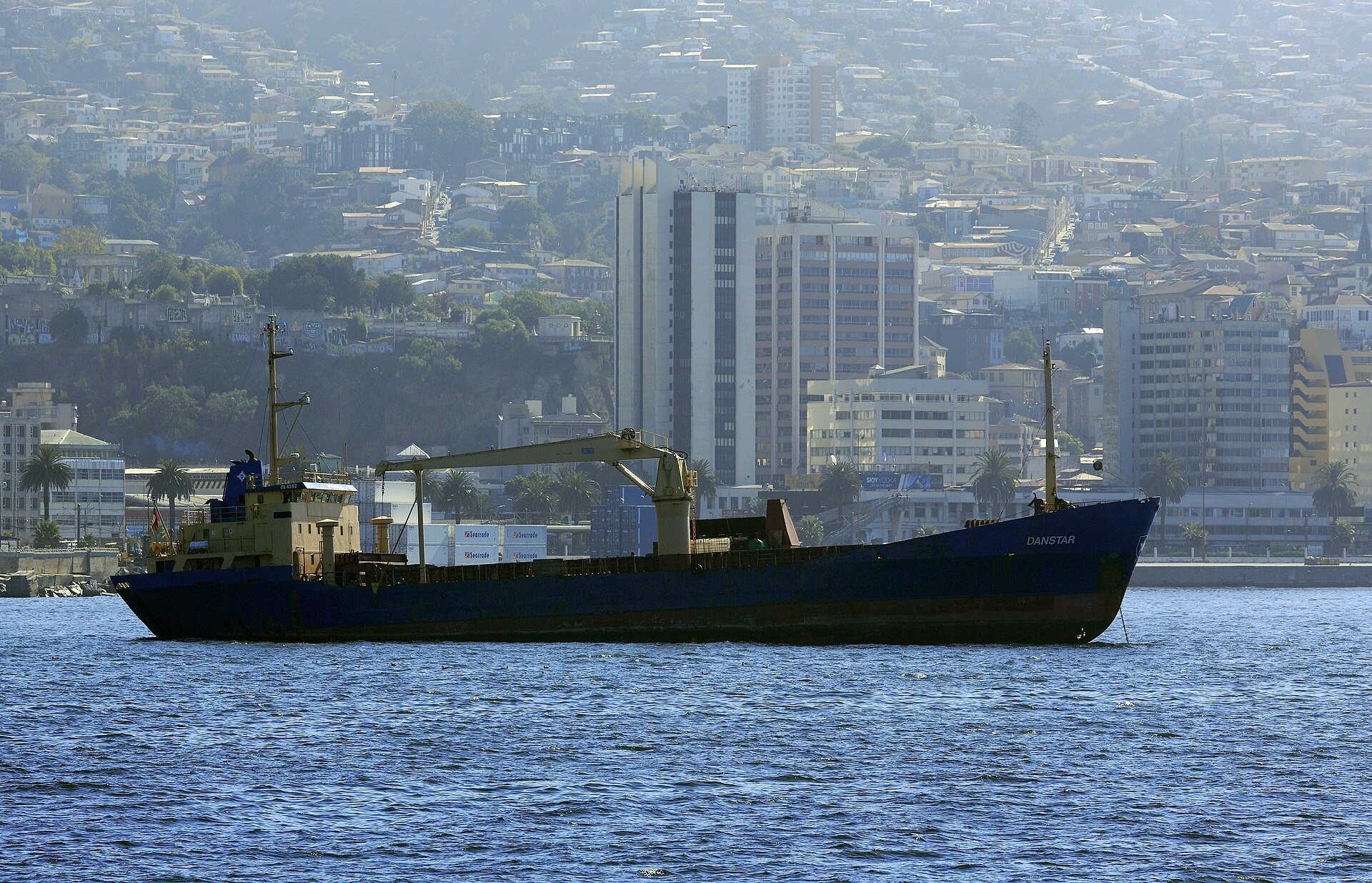
Argentina’s foreign minister says the Chilean cargo ship Danstar needs Argentine authorization to sail to the Malvinas (Falkland Islands) in December, and Chile’s foreign minister says Chile will not ask for it.
Foreign Minister Pablo Quirno told the A24 television channel on Nov. 9 that thousands of ships ask for authorization to cross Argentine waters on their way to the Malvinas. In comments reported on Nov. 12, he told Radio Rivadavia he expects the Danstar’s operator to ask too. An Argentine decree from 2010 requires prior authorization for any ship sailing between mainland Argentine ports and the islands, or crossing Argentine jurisdictional waters on the way there. Quirno has said the Strait of Magellan itself is Chilean; Argentina’s requirement covers the Argentine waters the ship would cross after leaving it.
Chile’s foreign minister, Francisco Pérez Mackenna, answered on Nov. 11. “Countries do not ask permission,” he said, adding that Chile believes in free navigation and innocent passage, a ship’s right to pass through coastal waters peacefully under the UN Convention on the Law of the Sea. Chile cites a 1984 treaty in which Argentina undertook to let ships of every flag pass through its jurisdictional waters to and from the Strait of Magellan without obstacles.
The Danstar is a Chilean-flagged cargo ship run by the Valparaíso shipping company Easter Island Naviera, due in Punta Arenas on Nov. 15 for about 20 days of shipyard work. It would reopen a route suspended for about 15 years, which businesses from the islands and Chilean suppliers worked on at a September trade forum in Punta Arenas. The Falkland Islands Development Corporation (FIDC), the islands’ own development agency, said in September that the first sailing was set for mid-November and now gives Dec. 17 as the estimated date. The company’s manager says departure will come in the second or third week of December, depending on shipyard repairs and weather, and the company calls Dec. 17 tentative.
The operator says the ship will carry fruit, vegetables, perishable food and building materials for houses, gardens and schools, and denies any link to oil. FIDC’s October list of potential cargo also includes heavy plant and machinery and vehicle spares. Argentina’s concern is that the route could supply Sea Lion, the offshore oil project that Argentina is asking a Law of the Sea tribunal to halt. Quirno has cited Chile’s commitment not to contribute logistically to resource exploitation in the islands.
A federal appeals court in Comodoro Rivadavia, in Patagonia, upheld on Nov. 10 a lower court’s refusal to order the navy and coast guard to stop the ship, in a case brought by the foundation Argentina Azul, according to El Diario del Fin del Mundo, a newspaper in Ushuaia. The judges found the foundation had not established its claim that the Danstar would serve Sea Lion, and said such an order would affect commitments under the 1984 treaty with Chile and belong to the executive branch.
In Argentina’s Congress, Deputy Agustina Propato, of the Peronist opposition coalition Unión por la Patria, has filed a bill that would classify the passage of ships bound for the islands as not innocent and let the navy or coast guard order them detained or diverted. Chilean media call it the “anti-Danstar law.”
Quirno said on Oct. 14 that Argentina’s relationship with Chile’s government is excellent and that Argentina has no intention of boarding or attacking the ship, and the Foreign Ministry denies seeking an incident. The International Tribunal for the Law of the Sea in Hamburg has tentatively set Nov. 28 to read its order on Argentina’s request to halt Sea Lion, less than three weeks before the ship’s estimated sailing date.