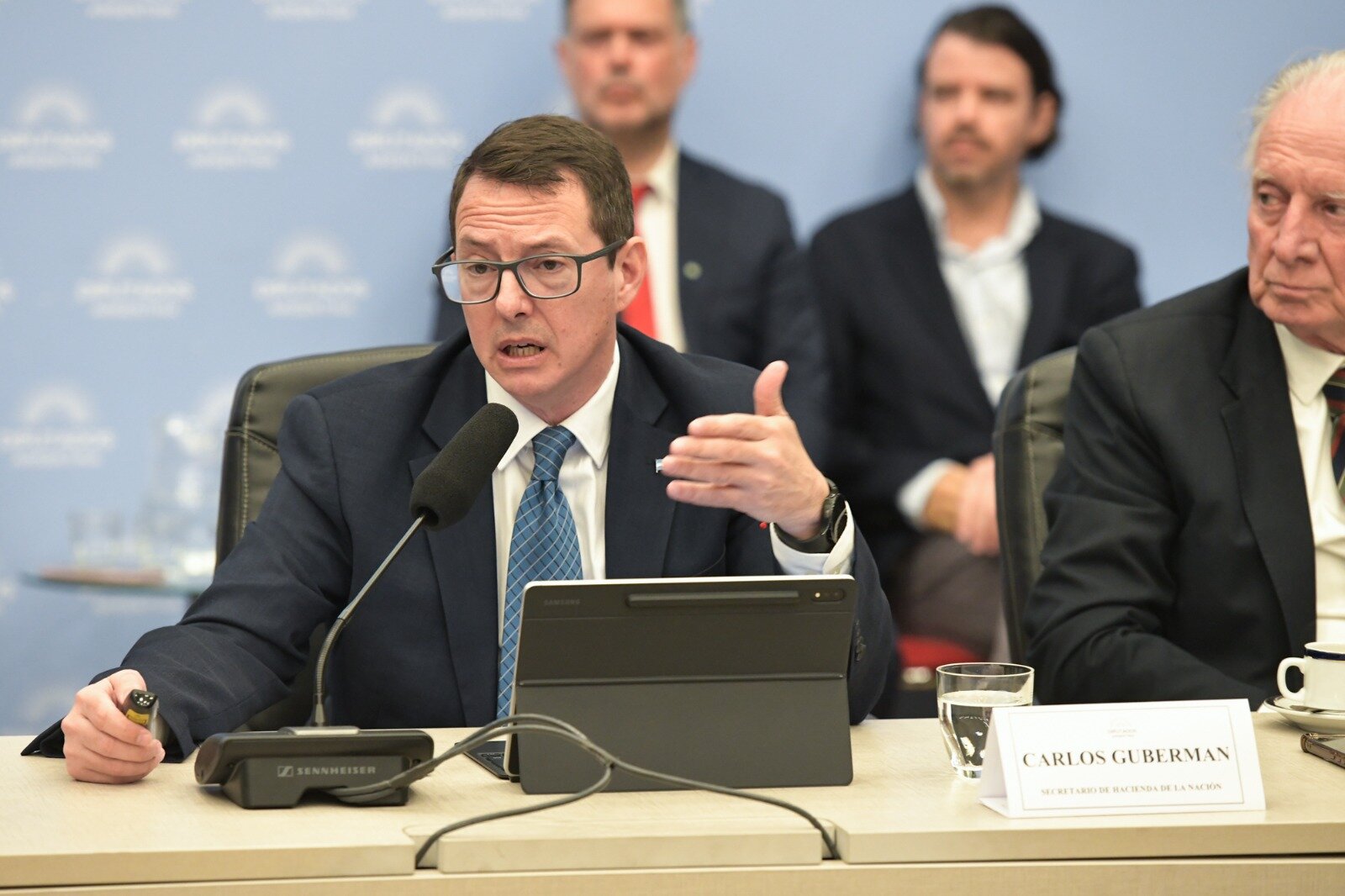
Deputies opened committee debate on Argentina’s 2027 budget on Tuesday, with Carlos Guberman, the Economy Ministry’s secretary of Hacienda (Treasury), defending a plan that assumes 4% growth, 18% inflation and a dollar at about 1,848 pesos by the end of next year.
The projections are more optimistic than outside forecasts. The IMF now expects 3.5% growth in 2027 and the central bank’s survey of private analysts (the REM) 3%. The budget also assumes a primary surplus, the balance before interest payments, of 1.3% of output. Opposition deputy Julia Strada noted that the 2026 budget assumed 10.1% inflation; INDEC, the national statistics agency, reported on Tuesday that prices have risen 23.6% in the first nine months of the year. Asked whether he expects a recession in the third quarter, Guberman shook his head.
Disability funding drew the sharpest exchanges. The draft sets aside 7.25 trillion pesos (US$4.7 billion at Banco Nación’s 1,535-peso selling rate on Oct. 13) for disability pensions and health care, and Guberman said 100% of whatever demand arises is covered. Pressed by opposition deputy Victoria Tolosa Paz on whether the government will withdraw the articles that dismantle the disability emergency law, he said the government’s own bloc in Congress holds a different position. “We would have wanted something else,” he said, adding that it is up to Congress.
Opposition deputies also demanded that the government comply with the university funding law, which a federal judge ordered applied immediately. University rectors say the law requires 11 trillion pesos (US$7.2 billion), well above the draft’s allotment. Guberman said the adjustment the law requires is included. Economy Minister Luis Caputo and Finance Secretary Federico Furiase are not scheduled to appear, and committee chair Alberto Benegas Lynch said Caputo would come only “if something is left in the inkwell.”
The budget reached Congress on Sept. 15. The ruling La Libertad Avanza bloc wants a committee vote on Oct. 28 and a floor session around Nov. 18, after Pope Leo XIV’s planned visit. Because the Senate would then have too little time to pass the bill before the ordinary session period ends on Nov. 30, the government is expected to call extraordinary sessions. The committee next hears Labor Secretary Julio Cordero on Wednesday and an education official on Oct. 20.