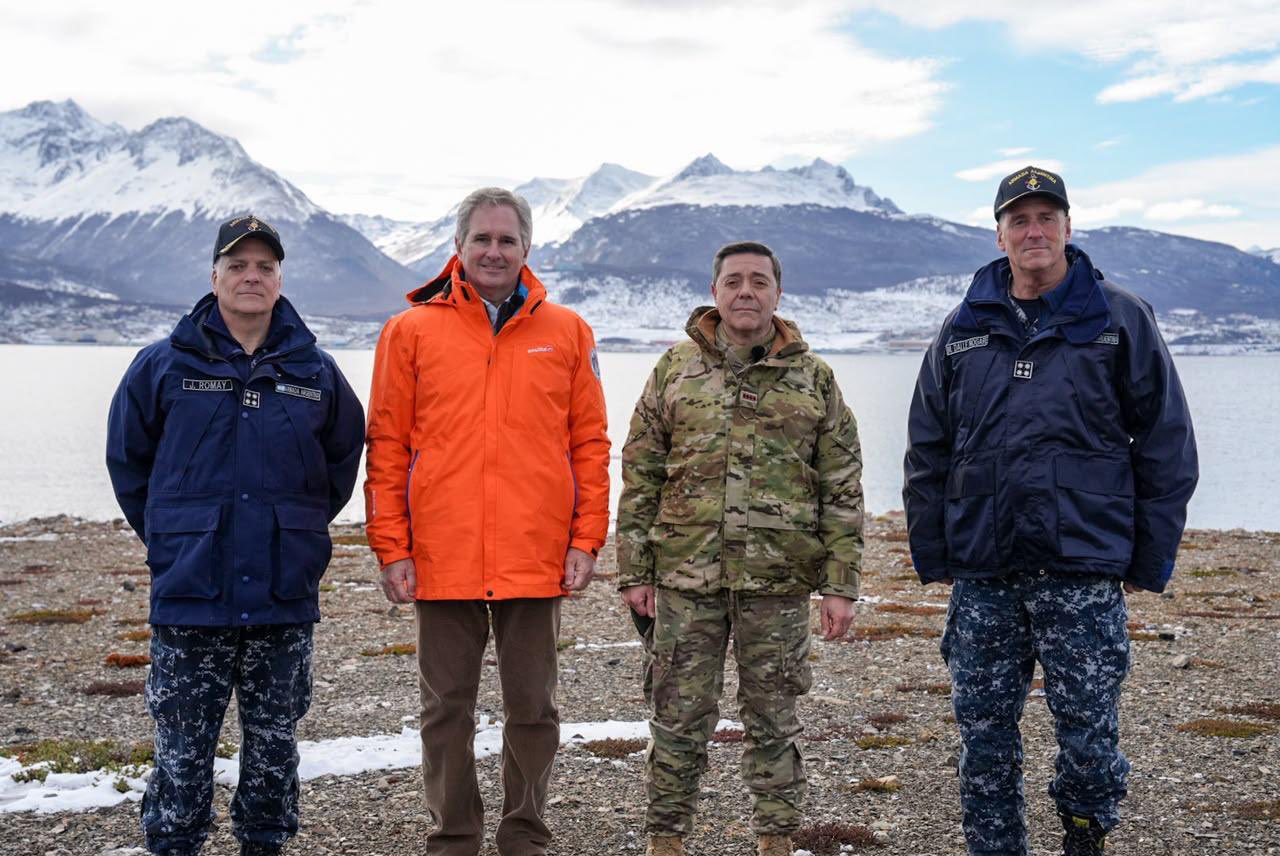
Argentina's Defense and Foreign Ministries said this week that funding is finally secured to revive the long-stalled Integrated Naval Base in Ushuaia, committing more than 300 billion pesos, roughly $200 million, to a project that has sat mostly dormant since ground was broken in 2022. Defense Minister Carlos Presti and Foreign Minister Pablo Quirno traveled to Tierra del Fuego on September 11 to tour the site in person, flanked by the Navy's top officers and provincial legislators.
Junto al ministro de Defensa, @TGCarlosPresti, visitamos el predio en el que se construirá la Base Naval Integrada en Ushuaia, el punto más austral de la Nación. Recorrimos con expertos de las Fuerzas Armadas el predio y analizamos los desafíos logísticos que implica un proyecto…
Translation: "Together with Defense Minister @TGCarlosPresti, we visited the site where the Integrated Naval Base will be built in Ushuaia, the nation's southernmost point. We toured the site with Armed Forces experts and discussed the logistical challenges a project…"
The announcement gives concrete numbers to a project that has long served as a symbol of the gap between Argentina's rhetoric about its southernmost frontier and the state's actual investment there. Four years after the foundation stone was laid under then-President Alberto Fernández, the site remains a single 2,500-square-meter concrete slab on a 38-hectare plot with no public access, according to reporting from the visit — roughly 9% complete by the government's own accounting.
Of the total, 217.954 billion pesos (US $144M) for 2026 is already available to the Defense Ministry under Decree 867, officials said, with more than 300 billion pesos (US $198M) in additional funding to be requested as part of the 2027 budget that Milei is set to present to Congress on September 15. Construction is expected to begin in January 2027 and run roughly 30 months, with the government targeting completion in late 2029.
The plan covers six phases: extending the pier to 585 meters after the first 240 meters are finished, building temporary work camps to sustain construction through the region's harsh winters, a maritime services building, full site utilities including water, power, gas and internet, a set of Antarctic logistics buildings for storage, refrigeration, workshops and fuel, and finally relocating the existing naval base to the new site starting in 2028, with housing for military personnel following in 2029.
“There's a presidential decision, there's a decree, and we have the resources for the first time in forty years,” Presti said during the visit, framing the funding commitment as a break from decades in which the base was announced but never built out. Quirno, for his part, emphasized that the project would be entirely self-financed. “Cien por ciento argentina,” he said — a hundred percent Argentine — explicitly tying the base to what he called the government's Malvinas (Falkland Islands) sovereignty strategy, while suggesting it could eventually offer logistics support to other countries' Antarctic expeditions.
Tierra del Fuego Governor Gustavo Melella, a political opponent of Milei's, joined part of the visit and signaled his willingness to collaborate on the project, a notable point of alignment given how little common ground the governor and the national government have found on most other issues. The delegation also included Joint Chiefs of Staff representative Marcelo Dalle Nogare, Navy commander Admiral Juan Carlos Romay, and four national legislators from the province.
The funding announcement lands alongside a broader package of sovereignty-linked spending: officials also confirmed 120 billion pesos (US $79M) redirected to Argentina's space agency, CONAE, for satellite and space-surveillance infrastructure covering the South Atlantic. It follows Milei's recent national address on the Malvinas dispute and a decree ordering all state agencies to align their foreign dealings with Argentina's sovereignty claim over the islands, part of a broader hardening of the government's posture that has also touched oil companies operating near the disputed waters.
The base's history of stalled promises means the new numbers will likely be met with some skepticism in Ushuaia itself, where residents and local analysts have watched similar announcements come and go since 2022 with little to show on the ground. Whether that changes will depend on two things outside the government's full control: whether Congress approves the additional 2027 funding amid its own tense budget negotiations with governors, and whether construction actually breaks ground in January as promised. For a city whose economy is increasingly built around its role as Argentina's gateway to Antarctica, a fully built naval base would mean real jobs and infrastructure; another delay would confirm what many in Ushuaia already suspect — that the south gets promises before it gets pavement.