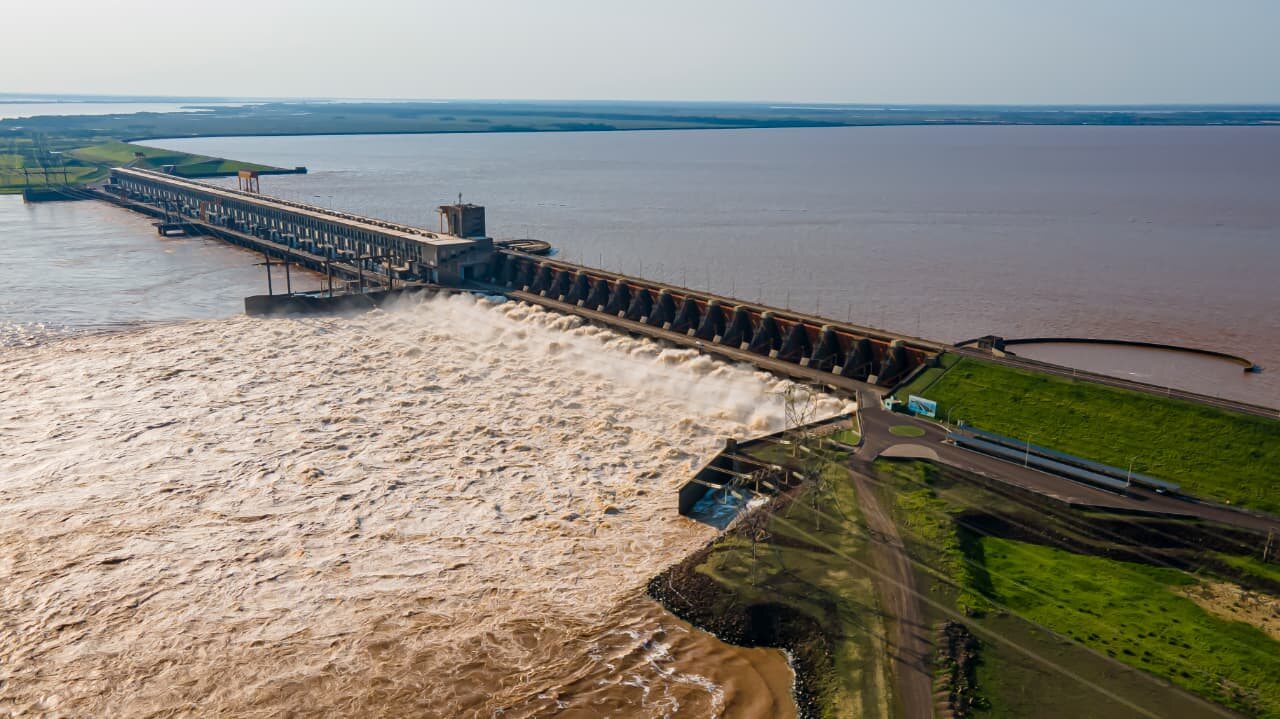
Rain linked to El Niño has pushed the Paraná and Uruguay rivers high enough to open the Yacyretá dam’s spillways, close Iguazú Falls and force ranchers to move cattle off low farmland across the Litoral, Argentina’s northeastern river region.
The Yacyretá Binational Entity (EBY), which runs the dam with Paraguay, reported that inflows were 37% above the 1971-2025 average in September and 40% above it so far in October, after rain over the Iguazú basin on Oct. 10-11 ran about five times the forecast. It opened the spillways on Monday, letting water pass without driving turbines, and closed the border crossing on top of the dam until at least Saturday, Oct. 17, suspending visitor tours as well. The EBY told Clarín the dam is not at risk: it was designed for flows of 95,000 cubic metres a second, and officials called this flood large but not unusual.
Iguazú National Park closed its upper and lower walkway circuits on Monday for the safety of visitors and staff. According to a Coast Guard survey, the Paraná is above its evacuation level at Iguazú and Libertador in Misiones province. On the Uruguay, Paso de los Libres in Corrientes is the only town above that level, where the river stood at 9.26 metres on Monday against an evacuation mark of 8.5, according to the National Water Institute (INA). About 30 people are lodged in an army facility there, and six families are evacuated in Concordia, in Entre Ríos province.
Ranchers are bearing the first costs. In Corrientes and Entre Ríos, producers are moving cattle from islands and low fields to higher ground, and flooded rural roads are slowing the work. “This is the beginning of what the El Niño effect is,” said Marcelo Carbonell, a former president of the Rural Society of Paso de los Libres. Water now high at Iguazú will travel downstream: the Rural Society of San Pedro, in northern Buenos Aires province, expects the rise to reach it in 25 to 30 days.
Yacyretá is running 18 of its 20 turbines near full output, about 2,600 megawatts shared with Paraguay. Clarín calculated that this displaces thermal power costing about US$40 a megawatt-hour with hydropower at about US$28 plus a US$10 premium paid to Paraguay, a slight saving for Argentine households and businesses. Salto Grande, on the Uruguay, is the reverse: Clarín reported it is using less than 1,200 of its 1,890 megawatts because high water has reduced the drop that drives its turbines.
The outlook is for more water. The National Meteorological Service (SMN) says above-normal rain is more likely from October to December, with the strongest signal in the Litoral and also in western Santa Fe, Córdoba, La Pampa and western Buenos Aires, and that intense storms can occur even where normal rain is expected. The World Meteorological Organization (WMO) put the chance that El Niño, a warming of the equatorial Pacific that shifts rainfall worldwide, lasts until February 2027 at close to 100%, and forecasts a record ocean-temperature anomaly this quarter. In an Oct. 11 alert, the EBY said high-water events could occur between October and December with a high probability.