Argentina’s central bank reserves closed above US$50 billion on October 15, lifted by US$15.48 billion of dollar purchases this year. Whether that pace can help meet 2027’s foreign-currency debt payments depends on a second, smaller measure: net reserves.
What the Numbers Measure
The central bank (BCRA) reported gross reserves of US$50,040 million on October 15, up US$318 million on the day, after buying US$182 million, according to BCRA data. Purchases since January total US$15,483 million, against an annual goal of US$10 billion that press reports describe as agreed with the IMF. Monthly purchases peaked at US$2,769 million in April and fell to US$473 million in September, the year’s lowest. In the first half of October they reached US$915 million.
The IMF does not test purchases or gross reserves. Its program measures net international reserves (NIR): gross official reserve assets minus gross official reserve liabilities, according to the technical memorandum in its May 2026 staff report. Those liabilities include foreign-currency debts of one year or less, the Fund’s own lending since the program began, and the swap lines with China’s central bank, the Bank for International Settlements and the US Treasury. So a swap, or an IMF disbursement, raises gross reserves but not net ones.
The IMF’s end-2026 floor is a cumulative change of minus US$4.1 billion from the end of 2024, which implies about US$8 billion of accumulation this year after a shortfall in 2025. Unlike gross reserves, which the central bank publishes daily, the net series is reported to the Fund and confirmed in its staff reports. Private estimates differ: Equilibra put accumulation at just under US$7 billion through July, with no gain in August or September, while Econviews’ series showed net reserves near minus US$7 billion in September. The IMF applies adjustments to its targets, so its own figure can differ.
Where the Dollars Come From
The purchases draw on grain and energy exports and on foreign borrowing by companies and provinces. Agricultural exporters supplied more than US$22 billion this year, and official estimates put company and provincial dollar bond placements since the midterm elections above US$20 billion. Romano Group, a consultancy, said the BCRA estimated about US$4.6 billion of those placements had yet to be converted as of September 30. Brent crude trades near US$100 a barrel, according to the consultancy NextBarrel.
The 2027 Bill
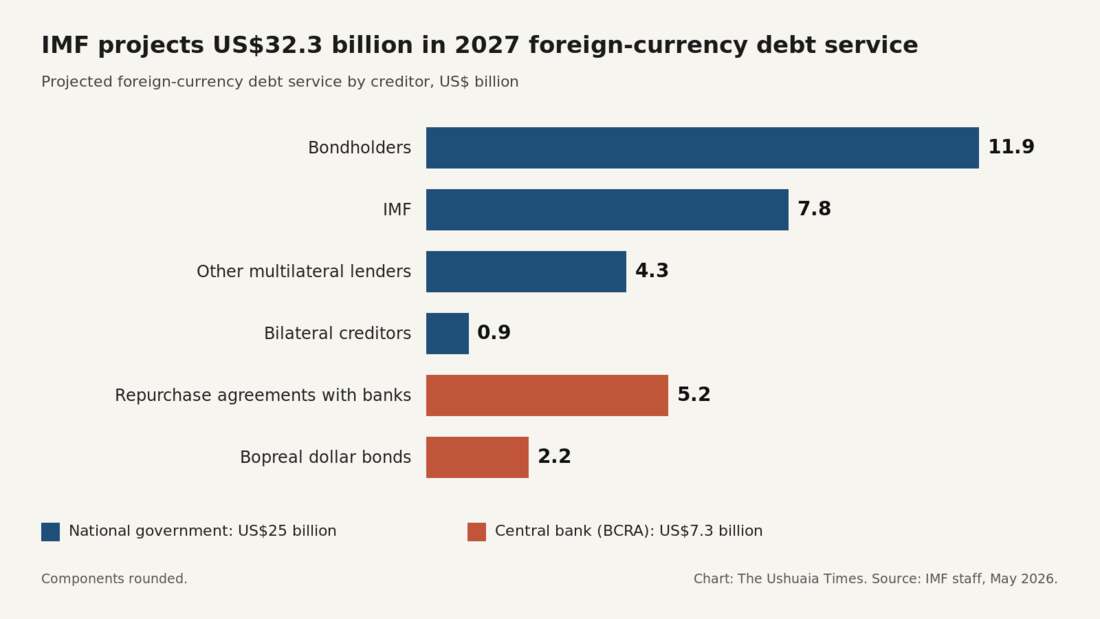
IMF staff projected in May that Argentina’s foreign-currency debt service would reach US$32.3 billion in 2027. Of that, US$25 billion falls on the national government: US$11.9 billion to bondholders, US$7.8 billion to the IMF, US$4.3 billion to other multilateral lenders and US$0.9 billion to bilateral creditors. The central bank owes the remaining US$7.3 billion, mainly repurchase agreements with banks (US$5.2 billion) and its Bopreal dollar bonds (US$2.2 billion). The staff table assumes US$6.3 billion of IMF and other official disbursements in 2027. A September tally on a narrower base (private bondholders, the IMF and Bopreal) came to more than US$21 billion, over 40% of the roughly US$49 billion of gross reserves at that time.
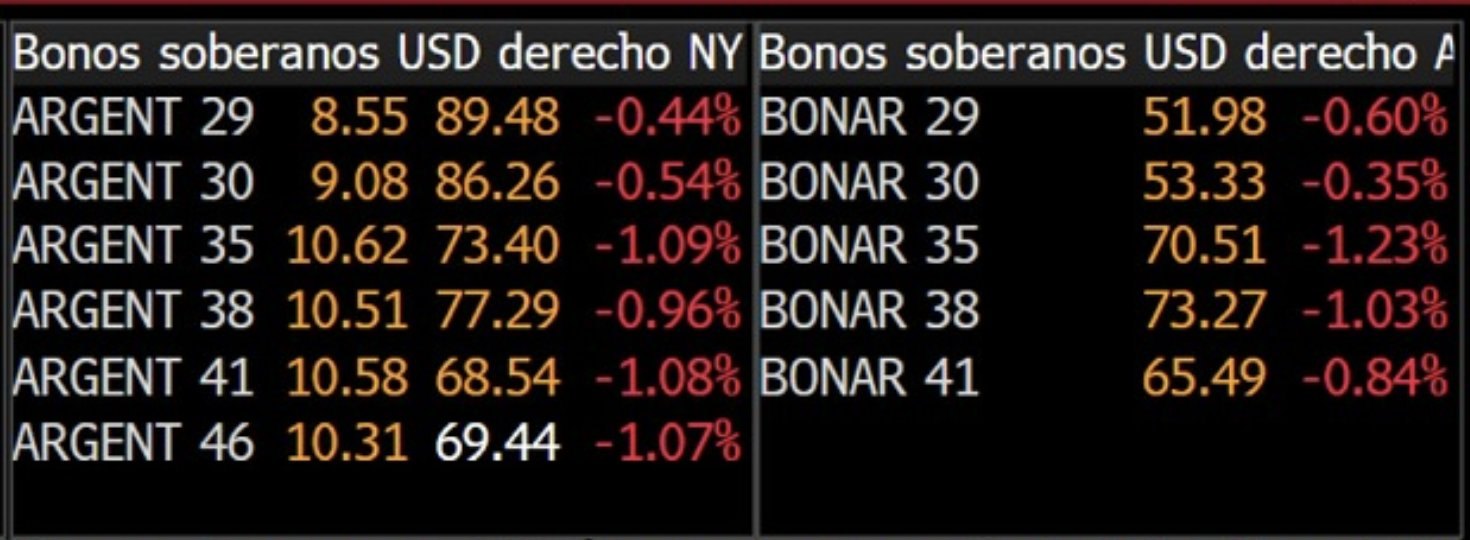
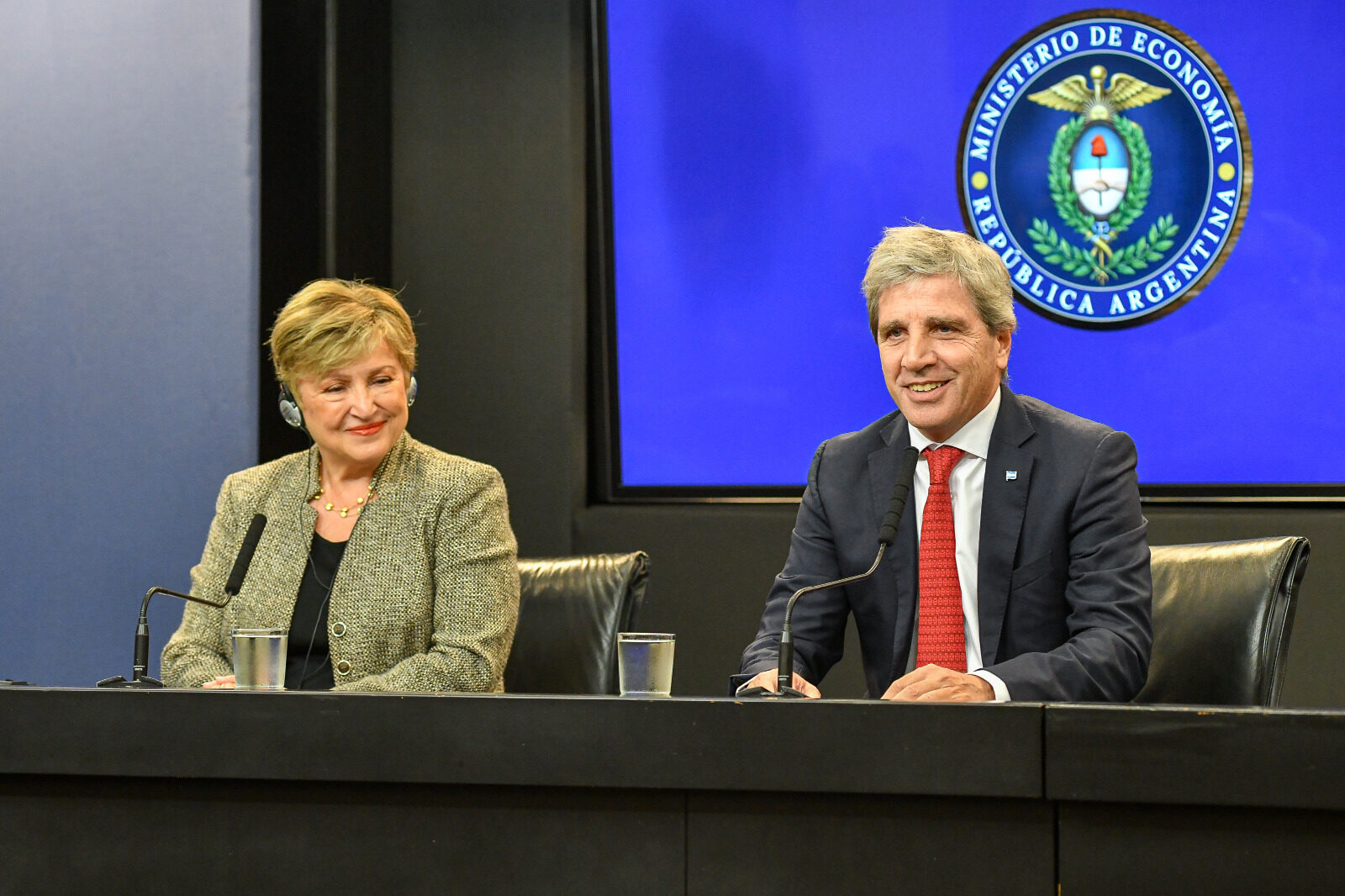
The bondholders and the IMF are owed by the Treasury, while purchases are made by the central bank. The government’s July financing plan counted on US$5 billion of Bonares, dollar bonds sold under local law, within a US$25 billion program. Economy Minister Luis Caputo suspended the auctions in mid-August, citing high US Treasury yields; the 10-year yield was 5.21% on October 14. Country risk, the extra yield investors demand on Argentine debt, closed at 622 basis points on October 15, up from a 2026 low of 403 on July 10. Caputo has told investors that international market access in 2027 would need a significant narrowing of country risk.
At a JPMorgan event in Bangkok, Caputo told investors the China swap, could be used if Bonares cannot be refinanced. The BCRA renewed the line in August for five years: about US$19 billion according to Ámbito (IMF staff put it near US$18 billion), with US$5 billion activated, equal to the planned Bonar issue. The US$20 billion US Treasury swap, he said, remains an option against market volatility, not for the Bonares.
Two Paths
If purchases continue near October’s pace, net reserves would move toward the IMF floor, and the bank’s cushion would grow ahead of the election year. The government says purchases could reach US$17 billion this year, about US$1.5 billion more than so far, and the unconverted corporate dollars are one source. That path still leaves Bonares or other financing to cover most of the Treasury’s US$25 billion.
If purchases slow, as in September, the gap to the IMF floor stays open and the 2027 plan leans more on the swaps and on market access, which depends on country risk and US rates. The IMF’s third review has no staff-level agreement; Argentina missed its first-half primary surplus target and is seeking a waiver, and about US$869 million tied to the review is pending. That money would raise gross but not net reserves.
Argentina owes the IMF US$865 million in November and US$340 million in December.